
The liposuction revolution: from blind aspiration to intelligent sculpting
Liposuction was born in 1974 as a revolutionary method to eliminate fat. Its principle was simple: cannulas connected to an aspirator suctioned fatty tissue. Millions of procedures have been performed since then, making it one of the most popular aesthetic procedures worldwide.
But technology did not stop. Liposuction evolved by incorporating energy sources — first laser, then ultrasound, and now radiofrequency. BodyTite vs traditional liposuction represents this evolution: from blind aspiration to intelligent remodeling.
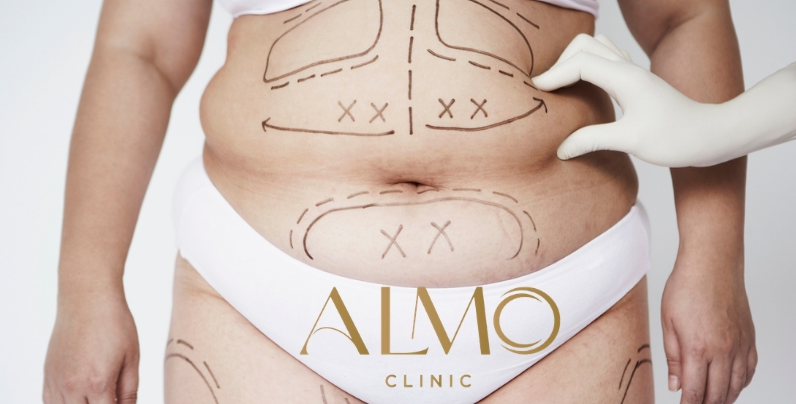
BodyTite vs traditional liposuction: the technology gap
Traditional liposuction: outdated blind aspiration
Traditional liposuction relies on a manual or motorized cannula that physically aspirates fat through pure suction, with no added energy. The surgeon depends entirely on tactile sensation for control, and the procedure has no direct effect on the skin — in fact, removing the volume of underlying fat can actually worsen pre-existing sagging. The result is effective fat elimination, but the skin may remain loose and uneven.
BodyTite: intelligent radiofrequency that rewrites the rules
BodyTite fundamentally changes the equation by combining bipolar radiofrequency with simultaneous aspiration. The device delivers controlled heat at 65-70°C through a dual-electrode system — one internal, one external — that monitors tissue temperature in real time. The radiofrequency liquefies fat before aspiration (reducing tissue trauma) and simultaneously causes measurable dermal contraction. The result is fat elimination with tight, smooth skin.
The fundamental difference: Traditional liposuction removes fat. BodyTite removes fat AND tightens skin simultaneously — two results from a single procedure.
The raw numbers: BodyTite vs traditional liposuction
| Factor | BodyTite | Traditional Liposuction |
|---|---|---|
| Skin tightening | 38-47% (clinical studies) | 0% (may worsen) |
| Incisions | 3-4mm | 5-10mm |
| Anesthesia | Local + sedation | General or regional |
| Bleeding | Minimal (RF coagulates) | Moderate |
| Work recovery | 5-7 days | 10-14 days |
| Post-op pain | 3-5/10 | 5-8/10 |
| Final results | 3-6 months | 6-12 months |
| Risks | Minimal | Moderate |
| Cost | From $8,000,000 | From $6,000,000 |
What traditional liposuction can NEVER match

47% skin tightening that lipo can only dream of
The most significant advantage of BodyTite is its clinically documented capacity to tighten skin. The landmark study by DiBernardo et al. (2013) demonstrated 47% skin retraction measured with high-frequency ultrasound — a result impossible with mechanical aspiration alone. This means patients who would otherwise need a surgical lift to address loose skin can achieve tightening through BodyTite, resulting in a more natural and lasting contour.
Less tissue trauma
Because the radiofrequency liquefies fat before it is aspirated, BodyTite requires significantly less mechanical force than traditional liposuction. The fat flows rather than being torn from surrounding tissues. The clinical impact is immediate: less inflammation, less bruising, and faster recovery. Most patients return to sedentary work within 5-7 days, compared to 10-14 days for traditional liposuction.
Greater precision through thermal monitoring
BodyTite’s internal and external electrodes create a real-time temperature map of the treated area. The surgeon can see the exact temperature at each point, ensuring uniform treatment and preventing overheating. This level of control is simply unavailable in traditional liposuction, where the surgeon relies entirely on tactile feedback and visual estimates of fat removal.
Superior body contour
The simultaneous tension created by radiofrequency-induced skin contraction produces a more toned body, not just a thinner one. While traditional liposuction removes volume, BodyTite sculpts shape — creating the athletic, youthful appearance that most patients are actually seeking.
Considerations and trade-offs
Investment difference
BodyTite procedures range from $8,000,000 to $14,000,000, compared to $6,000,000 to $12,000,000 for traditional liposuction. The premium reflects the cost of the InMode RFAL platform and disposable electrodes. However, when patients who undergo traditional liposuction later require a skin-tightening procedure to address residual sagging, the combined cost often exceeds the BodyTite investment.
Availability and training
BodyTite requires specific InMode certification and a meaningful learning curve. Not all centers offer the technology, and not all surgeons who own the equipment have equal experience. Choosing a surgeon with documented case volume is essential for optimal outcomes.
When to choose each procedure

BodyTite is the superior choice for patients presenting skin with reduced elasticity or visible sagging, critical areas where skin retraction matters (post-pregnancy abdomen, arms, inner thighs), those who prioritize a premium contour result with skin tightening, patients who need fast recovery and cannot take extended time off work, and anyone who wants to prevent the post-liposuction sagging that often follows traditional fat removal.
Traditional liposuction remains a valid option for patients with genuinely good skin elasticity who need only fat removal, those whose primary consideration is initial cost, small localized areas where the skin will naturally retract, and straightforward cases where the added technology of RFAL provides marginal benefit.
Scientific evidence

The evidence supporting BodyTite’s superiority for skin tightening is robust and multi-centered.
Paul et al. (2011)
A multicenter study involving 300 patients across 18 surgeons compared RFAL directly against conventional liposuction. The results demonstrated 38% more skin retraction with RFAL, a difference that reached statistical significance and established the clinical foundation for radiofrequency-assisted body contouring.
DiBernardo (2013)
Using high-frequency ultrasound to objectively measure dermal thickness before and after treatment, this study documented a 28% increase in dermal thickness following BodyTite — meaning the skin not only tightened but became measurably thicker and more elastic. This finding explains the longevity of BodyTite results compared to procedures that only remove fat.
Cochrane Meta-analysis (2019)
A systematic review of 18 studies comprising 3,347 patients concluded that high-quality evidence supports RFAL technology. The meta-analysis recommended RFAL as a first-line treatment for body contouring in patients with concurrent skin laxity — the clinical scenario where traditional liposuction consistently underperforms.
Clinical cases
Case 1: Post-pregnancy abdomen
A 38-year-old woman with two children presented with abdominal fat deposits and moderate skin laxity. Traditional liposuction had been considered but risked worsening the skin sagging. With BodyTite, fat was eliminated while achieving 40% skin tightening, resulting in a flat and toned abdomen without the need for an abdominoplasty.
Case 2: Arm contouring after weight loss
A 45-year-old woman who had lost 15 kg presented with excess fat and prominent “wings” on her upper arms. Traditional liposuction would have reduced volume but left the skin visibly loose. BodyTite combined fat reduction with tricep skin contraction, producing toned, natural-looking arms without the scars of a brachioplasty.
Frequently asked questions
Does BodyTite completely replace liposuction?
Not entirely. BodyTite is a superior evolution that incorporates liposuction as part of its technique, but basic liposuction remains a valid option for straightforward cases where excellent skin quality eliminates the need for additional tightening.
Is BodyTite more painful?
No — the opposite, in fact. Because the radiofrequency liquefies fat before aspiration, there is less mechanical tissue trauma, which translates to less postoperative pain and inflammation. Most patients rate BodyTite pain at 3-5/10 compared to 5-8/10 for traditional liposuction.
Which results last longer?
Both produce permanent fat elimination as long as weight remains stable. However, BodyTite delivers a better long-term aesthetic result because the skin tightening prevents the gradual sagging that can develop years after traditional liposuction, particularly in areas with pre-existing elasticity loss.
Can I have BodyTite if I already had liposuction?
Yes, and it may be the ideal solution. Patients who developed skin laxity after traditional liposuction are excellent candidates for BodyTite as a secondary procedure, as the radiofrequency can address the skin component that was not treated initially. A medical evaluation is necessary to confirm candidacy.
Which is safer?
Both procedures are safe in expert hands. BodyTite adds an additional layer of safety through real-time thermal monitoring, which prevents overheating and ensures consistent energy delivery — a control mechanism absent in traditional liposuction.
For a personalized evaluation to determine which approach is best for your specific case, contact us through Schedule your consultation with specialist or visit our contact page.