If you are researching treatments for facial laxity, double chin, or non-surgical rejuvenation, you have likely encountered both Morpheus8 and HIFU (Liftera, Ultherapy). Both promise results without surgery, but they work in fundamentally different ways and produce markedly different outcomes depending on the severity of laxity.
At ALMO Clinic, we have performed 500+ Morpheus8 procedures and 300+ HIFU (Liftera) procedures, which gives us a uniquely informed perspective on when to recommend each technology. In this technical analysis, we compare both treatments without commercial bias.
What is each technology?
Morpheus8: Fractional Radiofrequency with Microneedles
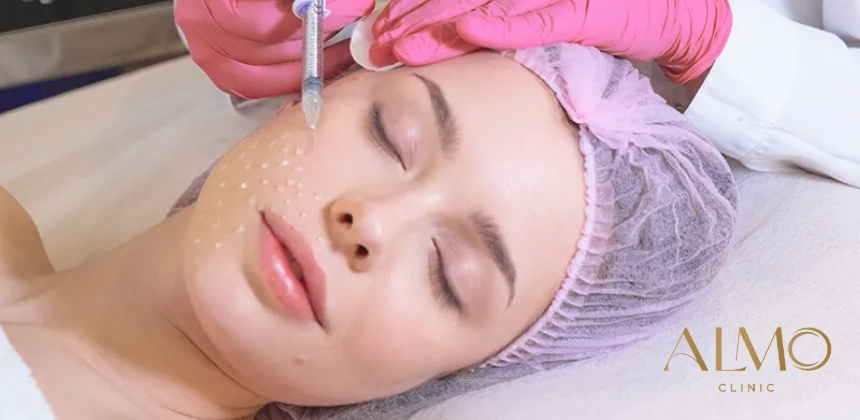
Morpheus8 combines 24 independent microneedles that penetrate between 2 and 7 mm with bipolar fractional radiofrequency that heats the deep dermis to 67°C. Its mechanism of action involves dual stimulation — the microneedles create controlled micro-channels (mechanical stimulus), while the radiofrequency generates thermal coagulation zones at precise depth. This triggers a cascade of neocollagenesis that produces new type I and III collagen over 3 to 6 months, with immediate skin retraction on day zero followed by progressive remodeling. Its adjustable depth of 2 to 7 mm targets the deep reticular dermis where collagen is actively produced.
HIFU: High-Intensity Focused Ultrasound
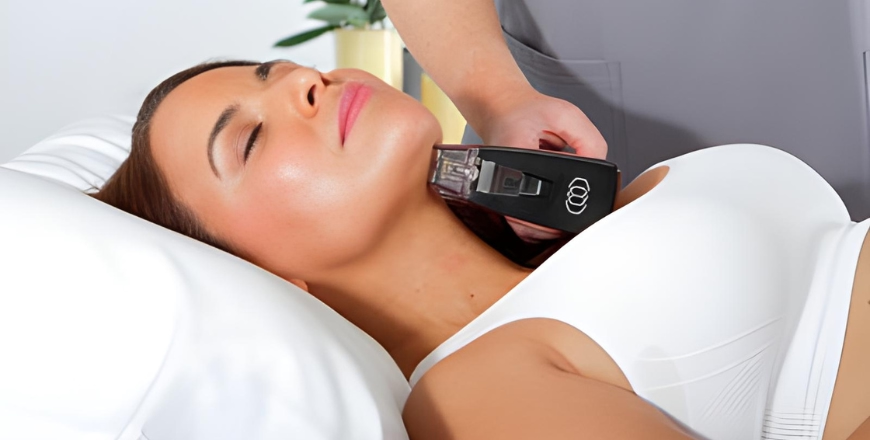
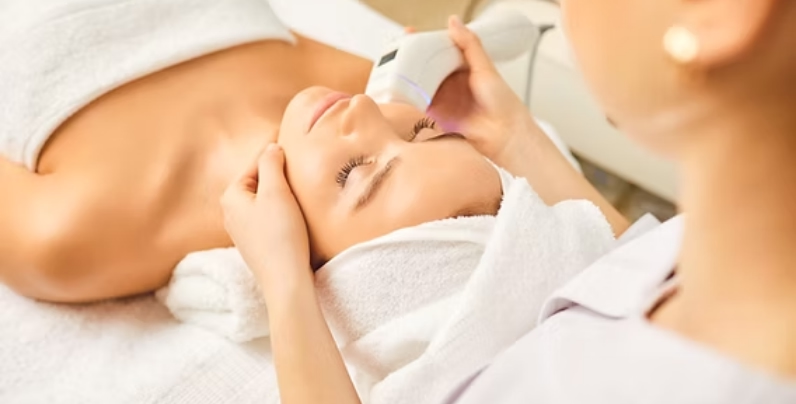
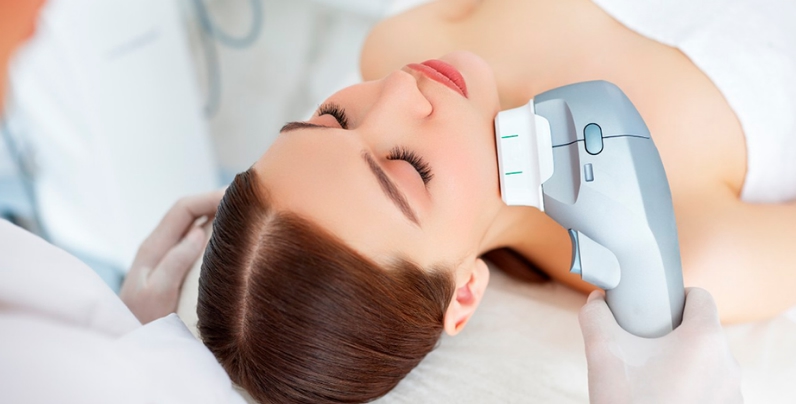
HIFU uses focused ultrasound waves that generate pointed heat at a specific depth without damaging the surface. The acoustic energy converges at a focal point, creating thermal coagulation temperatures of 60-70°C at precise spots. This causes immediate contraction of the SMAS (Superficial Musculoaponeurotic System), producing a natural lifting effect from contraction of deep structures. Unlike Morpheus8, HIFU operates with fixed cartridges at depths of 1.5 mm, 3.0 mm, and 4.5 mm — not continuously adjustable.
Key difference: Morpheus8 creates a “field” of continuous stimulation across the deep dermis. HIFU creates isolated “points” of stimulation at the SMAS layer. In practical terms: Morpheus8 delivers diffuse deep remodeling, while HIFU delivers pointed deep contraction.
Quick comparison table
| Factor | Morpheus8 | HIFU (Liftera) | Winner |
|---|---|---|---|
| Technology | RF + microneedles | Focused ultrasound | Technical tie |
| Depth | 2-7mm adjustable | 1.5-4.5mm fixed | Morpheus8 |
| Precision | High (24 independent needles) | Medium (heat points) | Morpheus8 |
| Pain | 3-4/10 with topical anesthesia | 5-6/10 without anesthesia | Morpheus8 |
| Downtime | 2-3 days | 0-1 day | HIFU |
| Redness | Moderate 24-48h | Minimal or absent | HIFU |
| Laxity results | 70-85% improvement | 40-60% improvement | Morpheus8 |
| Texture results | Excellent (pores, scars) | Minimal | Morpheus8 |
| Results duration | 2-5 years | 12-18 months | Morpheus8 |
| Sessions needed | 1-3 sessions | 2-3 sessions | Tie |
| Procedure time | 45-90 minutes | 30-60 minutes | HIFU |
| Price per session | $2,700,000 | $1,800,000 | HIFU |
| Long-term cost-benefit | Superior | Inferior | Morpheus8 |
| Skin phototypes | I-VI (all) | I-IV (limited V-VI) | Morpheus8 |
| FDA approved | Yes (all phototypes) | Yes | Tie |
Quick verdict: Morpheus8 wins in 10 of 16 factors, HIFU in 3, with 3 ties.
Deep comparison by categories
1. Mechanism of action: how do they really work?
Morpheus8: dual stimulation (mechanical + thermal)
The treatment unfolds in distinct phases. During the first two seconds, 24 gold microneedles penetrate the skin simultaneously at the programmed depth (2 to 7 mm), creating controlled micro-channels. In seconds 2 through 4, bipolar radiofrequency is released exclusively in the deep dermis — not the epidermis — reaching 67°C and creating thermal coagulation zones of 1-2 mm in diameter.
The immediate result on day zero is a contraction of existing collagen fibers, producing an initial 15-20% improvement in firmness. Over the following 1 to 12 weeks, activated fibroblasts produce new type I collagen (firmness) and type III collagen (elasticity), accompanied by extracellular matrix remodeling. The process culminates at month 6 with full maturation of the new collagen and maximum results.
HIFU: deep thermal contraction
HIFU operates through a different pathway. In milliseconds, ultrasound waves converge at a specific focal point without direct contact with the epidermis, maintaining surface integrity. The focused acoustic energy generates pointed temperatures of 60-70°C, creating coagulation points measuring approximately 1 mm by 7 mm. The SMAS contracts immediately, producing 1-3 mm of elevation — an immediate lifting effect that is actually more noticeable on day zero than Morpheus8 (20-30% versus 15-20%). However, the secondary neocollagenesis that follows over weeks 4-12 is less intense than with Morpheus8, as pointed thermal stimulation generates a weaker healing response than the diffuse field stimulation of microneedle radiofrequency.
2. Ideal indications: when to choose each technology?
Morpheus8 is the superior choice for:
Moderate to severe laxity (grades II-III) — pronounced double chin with sagging skin, cheeks with volume loss and sagging, blurred jawlines, and necks with visible platysma bands respond optimally to its deeper reach. Combined texture and laxity problems represent another sweet spot, as Morpheus8 simultaneously improves acne scars, dilated pores, stretch marks, and deep wrinkles alongside firmness restoration. Patients with high skin phototypes (V-VI) should choose Morpheus8, which is FDA-approved for all phototypes with zero hyperpigmentation risk. It is also the right choice for patients seeking lasting results who can accept 2-3 days of downtime in exchange for outcomes that persist 2-5 years, and for body areas such as the postpartum abdomen, sagging arms, inner thighs, and buttocks with cellulite.
HIFU (Liftera) is the better choice for:
Mild laxity (grade I) — early facial sagging, very subtle double chin, slightly blurred jawlines, and preventive treatment in patients aged 30-40. Its greatest advantage is for patients with no recovery time available, such as those with social events in 24-48 hours or immediate face-to-face work requirements. HIFU also excels as a complement to other treatments — post-surgery to prolong results, combined with Morpheus8 in the collagen bomb protocol, or as annual maintenance after surgical lifting. Patients with a limited initial budget benefit from the lower per-session investment while still achieving acceptable gradual results.
Important: HIFU is not recommended for severe laxity (requires surgery or Morpheus8), acne scars or irregular texture (HIFU does not improve these), very dark skin phototypes V-VI (burn risk on some devices), or patients expecting Morpheus8-level results.
3. Pain and comfort during the procedure
With professional topical anesthesia (lidocaine + prilocaine applied 45-60 minutes before with film occlusion for maximum absorption), Morpheus8 registers 3-4 out of 10 on the pain scale. Patients describe the sensation as pressure combined with deep heat, similar to a firm massage. The jaw and forehead can be more intense due to proximity to bone, but 94% of patients characterize the experience as “very tolerable.”
HIFU, typically performed without anesthesia using only conductive gel, sits at 5-6 out of 10 on the pain scale. Patients describe pulsing deep heat with “internal pinches,” particularly along the jaw and in areas with minimal tissue. Approximately 70% of patients describe it as “tolerable but uncomfortable.”
Patient perspective on Morpheus8: “I felt pressure and heat, like a deep massage. Nothing painful. I was surprised at how comfortable it was.” — Ana M., 48 years old
Patient perspective on HIFU: “I felt deep heat with each shot, especially on the jaw. Tolerable but not comfortable.” — María F., 51 years old
4. Recovery and downtime
The recovery profiles of these two technologies differ significantly and often determine which one patients choose.
| Timeline | Morpheus8 | HIFU (Liftera) |
|---|---|---|
| Day 0 | Redness 7/10, mild-moderate swelling, visible pinpoint marks, residual heat sensation | Redness 2/10 minimal, almost no swelling, no visible marks, slight touch sensitivity |
| Days 1-2 | Peak redness 6-7/10, maximum swelling, possible small bruising (10%), home work OK but no social | Possible very mild submandibular swelling (20%), zero redness, 100% normal activity |
| Days 3-5 | Redness drops to 3-4/10, swelling reduced 60%, fine flaking begins, face-to-face work OK with makeup | No visible signs of treatment, subtle initial results |
| Day 7 | Almost normal appearance, complete flaking, first visible results, 100% normal including intense exercise | Full results developing |
HIFU has a clear advantage in immediate recovery. Morpheus8 requires 2-3 days of social downtime but delivers substantially more transformative results.
5. Results timeline and improvement percentages
| Period | Morpheus8 | HIFU (Liftera) |
|---|---|---|
| Weeks 1-2 | 20-30% initial improvement, smoother texture, visibly reduced pores | 30-40% improvement (higher than Morpheus8), immediate SMAS lifting effect |
| Month 1 | 40-50%, increased firmness to touch, more defined contour | 35-45%, maintained lifting, no texture improvement |
| Month 3 | 60-70%, very evident results, active neocollagenesis | 40-50%, near maximum results, secondary neocollagenesis |
| Month 6 | 70-85% final result, maximum achieved, lasts 2-5 years | 40-60% final result, stable, lasts 12-18 months |
Morpheus8 produces superior improvement (+25-40% more) with significantly longer duration (2-3x). HIFU has the advantage in immediate visible results during the first two weeks.
6. Combined protocol: the “Collagen Bomb”
For moderate-severe laxity, the most effective approach at ALMO Clinic combines both technologies in a carefully sequenced protocol. The treatment begins with a Morpheus8 session at month zero, using depths of 5-7 mm in laxity zones to establish the foundational collagen remodeling in the deep dermis. Six to eight weeks later, a HIFU Liftera session targets the SMAS at 4.5 mm depth, adding deep structural contraction to the remodeling already underway. A final Morpheus8 session at months 3-4 reinforces and optimizes the collagen network at 4-6 mm depth, consolidating results.
The combined protocol achieves 85-90% improvement — significantly superior to the 70% achievable with Morpheus8 alone or the 50% with HIFU alone. The results last 3-5 years, and the proven synergy produces outcomes greater than the mathematical sum of each technology individually.
| Protocol Component | Investment |
|---|---|
| 2 Morpheus8 sessions (package with discount) | $4,590,000 |
| 1 HIFU session | $1,800,000 |
| Total combined protocol | $6,390,000 |
| Comparison: surgical facelift | $8,000,000-$15,000,000 |
This protocol is ideal for patients with severe double chin who prefer to avoid surgery, facial laxity grades II-III, patients aged 45-60 with moderate sagging, and those presenting combined concerns of fat, laxity, and texture.
Comparative prices Bogotá 2026
Morpheus8 — ALMO Clinic
| Zone | Price per session | 3-session package (15% OFF) |
|---|---|---|
| Forehead/Periorbital | $1,500,000 | $3,825,000 |
| 1/3 Facial | $2,200,000 | $5,610,000 |
| Full face | $2,700,000 | $6,885,000 |
| Face + neck | $2,900,000 | $7,395,000 |
HIFU (Liftera) — ALMO Clinic
| Zone | Price per session | 3-session package (15% OFF) |
|---|---|---|
| Full face | $1,800,000 | $4,590,000 |
| Face + neck | $2,200,000 | $5,610,000 |
Three-year cost-benefit analysis
When evaluated over a three-year horizon, the investment profile shifts meaningfully. Morpheus8 requires an initial outlay of $6,885,000 for three face sessions, with results lasting a minimum of three years and a single maintenance session at year three costing $2,700,000 — a total of $9,585,000 or approximately $3,195,000 per year. HIFU starts lower at $4,590,000 for three sessions, but its 12-18 month duration necessitates two additional maintenance cycles over three years at $3,600,000 each — totaling $11,790,000 or approximately $3,930,000 per year. Morpheus8 is more expensive initially but saves 23% over the long term.
Real cases: Morpheus8 vs HIFU at ALMO Clinic
Case 1: Moderate laxity — Morpheus8 chosen
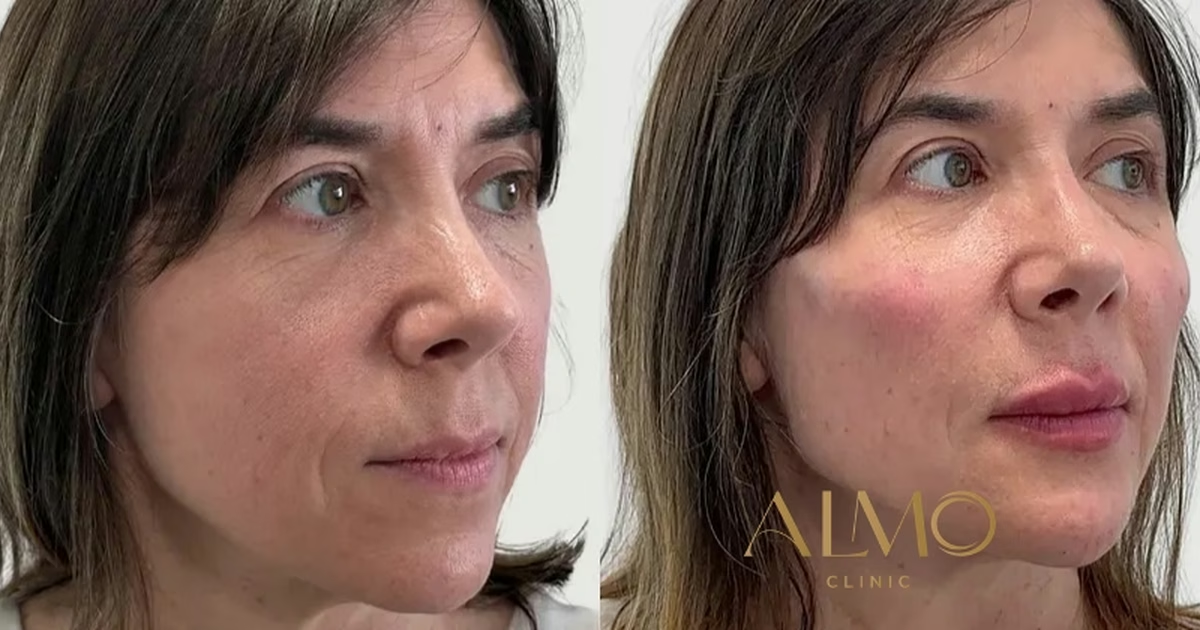
A 52-year-old woman with phototype III presented with cheek laxity, double chin, and dilated pores. She received three Morpheus8 sessions on face and neck at 5-6 mm depth with medium-high energy, achieving 80% improvement at 6 months for an investment of $7,395,000. Her words: “I considered HIFU for less downtime, but my laxity was significant. Morpheus8 was the right decision. The 3 days of recovery were totally worth it for results I’ve maintained for 2 years.”
Case 2: Mild laxity — HIFU chosen
A 38-year-old woman with phototype II sought treatment for early cheek sagging as a preventive measure. Two HIFU Liftera sessions using combined 3.0 mm and 4.5 mm depths produced 50% improvement at 4 months for an investment of $3,060,000. As she described it: “I had very mild laxity and needed zero recovery time. HIFU was perfect. Subtle results but exactly what I was looking for. I’ll return in a year and a half for maintenance.”
Case 3: Combined protocol — maximum results
A 56-year-old woman with phototype IV presented with severe double chin, facial laxity, and neck bands. Three surgeons had recommended surgical lifting. She opted for the collagen bomb protocol: two Morpheus8 sessions plus one HIFU session. The result: 88% improvement at 6 months for an investment of $6,390,000. Her testimonial speaks for itself: “Three surgeons recommended surgical lifting. I chose the combined protocol. Nearly surgical results without risks, without scars, without general anesthesia. The best decision of my life.”
Frequently asked questions
Which hurts more, Morpheus8 or HIFU?
With professional topical anesthesia, Morpheus8 is less painful (3-4/10) than HIFU without anesthesia (5-6/10). The key is applying the topical anesthesia 60 minutes before with occlusion for maximum absorption. HIFU produces pulsing deep heat that many patients describe as “internal pinches,” while Morpheus8 with anesthesia feels like “tolerable pressure and heat.”
Is Morpheus8 better than HIFU for double chin?
Yes, for moderate-severe double chin. Morpheus8 treats fat, laxity, and texture simultaneously, while HIFU only tightens the SMAS without improving fat deposits or surface texture. For a mild double chin with only laxity, HIFU may be sufficient. For double chin with accumulated fat, Morpheus8 is clearly superior.
Can Morpheus8 and HIFU be done on the same day?
Not recommended. Both generate deep thermal trauma, and performing them simultaneously risks excessive inflammation without additive benefit. The correct protocol spaces sessions 4-8 weeks apart to allow neocollagenesis from each technology to develop independently. The “collagen bomb” protocol alternates Morpheus8, then HIFU, then Morpheus8 with 6-8 weeks between each session.
Which technology has better long-term results?
Morpheus8 produces more lasting results (2-5 years versus 12-18 months for HIFU) because it generates deep remodeling of type I and III collagen throughout the reticular dermis. HIFU mainly produces temporary SMAS contraction that progressively relaxes. At the three-year mark, Morpheus8 patients maintain 60-70% improvement compared to 20-30% for HIFU.
Is HIFU faster than Morpheus8?
Yes, significantly. HIFU takes 30-60 minutes with no prior anesthesia preparation. Morpheus8 requires 45-60 minutes of topical anesthesia plus 45-90 minutes of procedure, totaling 90-150 minutes. However, Morpheus8 requires fewer total sessions to achieve superior results, so the cumulative time investment may be comparable.
Morpheus8 or HIFU for dark skin (phototype V-VI)?
Morpheus8 is the only safe option. It is FDA-approved for all phototypes (I-VI) without hyperpigmentation risk because the radiofrequency is delivered subdermally through microneedles, bypassing the melanin-rich epidermis entirely. HIFU carries burn risk in dark skin because acoustic energy can be absorbed by epidermal melanin. At ALMO Clinic, patients with phototype V-VI receive exclusively Morpheus8.
How to decide: a practical framework
The decision between Morpheus8 and HIFU ultimately depends on three factors: the severity of your laxity, the amount of downtime you can afford, and your budget horizon.
Morpheus8 is the right choice when you have moderate-to-severe laxity, combined texture and firmness concerns, dark skin (phototype V-VI), and you prioritize lasting results worth 2-3 days of downtime. HIFU is the ideal choice for mild laxity or preventive treatment, when you need zero downtime and cannot take even one day off, or when your initial budget is limited and you prefer to start with a more accessible entry point. The combined protocol represents the pinnacle of non-surgical rejuvenation — for severe laxity where surgery is not desired, it delivers near-surgical outcomes through the proven synergy of both technologies.
At ALMO Clinic, we determine which technology is ideal for your specific case through laxity grade analysis, skin elasticity measurement, phototype evaluation, and standardized clinical photography. The recommendation is always based on objective clinical evidence, not commercial preference.
For a personalized evaluation, contact us through WhatsApp or visit our contact page.
Related articles: