Complete breast augmentation recovery guide for international patients. The drop-and-fluff process explained, compression bra protocol, exercise restrictions by week, and scar care. What to expect and when to worry.

Breast augmentation recovery is faster than most patients expect. The majority can resume light activities in 3–5 days and desk work in week 2. However, two characteristics consistently surprise patients who weren't prepared for them.
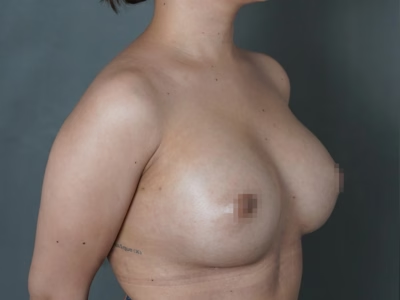
First, the implants appear high and tight in the first two to three weeks. This is not a complication or a sizing error — it is the predictable result of a contracted pectoral muscle and a skin envelope under tension. As the muscle relaxes and the pocket expands, the implant descends and the lower pole fills out over 3–6 months. This is what North American patients call "drop and fluff" — and it means that the appearance at week 2 is not the final result. Second, a tight pressure sensation across the chest during the first days is normal, particularly with submuscular placement. It resolves progressively and does not indicate a problem.
| Period | Expected symptoms | Allowed | Restrictions |
|---|---|---|---|
| Days 1–3 | Tightness and pressure in chest. Limited arm movement | Rest. Gentle movements. Sleep with upper body slightly elevated | No raising arms above head. No driving |
| Days 4–7 | Maximum swelling. Implants riding high (normal) | Light household activities with arms low. Short walks | No lifting over 2 kg. No driving with submuscular placement |
| Week 2 | Swelling reducing. Suture removal visit | Desk work. Driving (inframammary approach) | No exercise. No lifting over 3 kg |
| Weeks 3–4 | Implants beginning to drop. Sensation changes are normal | Normal work. Light stationary bike. No swimming yet | No chest or shoulder weight exercises |
| Weeks 5–8 | More natural appearance. Sensation recovering | Full cardio. Light weights. Swimming from week 6 | No intense chest exercise until week 8 |
| Months 3–6 | Final implant position and appearance | No restrictions | — |
The wire-free support bra is worn day and night for 4 to 6 weeks — removed only for bathing. The compression stabilizes implants during integration, reduces swelling, and supports the scar. Using a regular underwire bra too early puts pressure on the implant pocket and inframammary incision before the tissue has consolidated.
For bathing, a soft sports band can substitute temporarily. Underwire bras are reintroduced at weeks 8–10. Following this schedule is not optional — it directly affects the pocket healing process.
The incision scar passes through three phases: inflammatory (red, may itch — weeks 1–6), proliferative (thickening — months 2–3), and remodeling (progressive fading — months 4–18). During the second and third phases, topical silicone gel or silicone sheets can optimize the final scar appearance.
Protecting the scar from sun exposure with SPF 50+ for the first year prevents hyperpigmentation. Sun exposure on an immature scar can produce permanent darkening. For inframammary incisions that remain covered by a bra, this is rarely a practical concern — but for patients spending time at the beach during recovery, it matters.
The ALMO Clinic team supports your complete recovery process, including virtual follow-up consultations after you return home.