Complete breast reduction recovery guide for international patients traveling to Colombia. Surgical bra protocol, activity restrictions by week, scar care, and what to expect on the flight home.

Breast reduction has a reputation for difficult recovery that doesn't match most patients' actual experience. The functional recovery — being able to manage daily activities, dress independently, and return to desk work — takes 2 weeks in most cases. By day 3–5, the majority of patients are moving around comfortably with medical support. The factors that require time are not pain but rather the progressive scar maturation (12–18 months) and avoiding upper body strain during the first 6–8 weeks.
For international patients flying home from Bogotá, the practical window is 10–12 days — enough time for the drains (if used) to come out, the incisions to be confirmed as stable, and the surgeon to clear you for the flight.
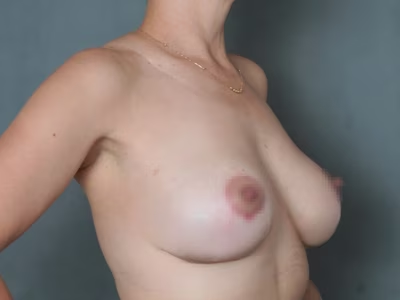
| Period | Expected symptoms | Allowed | Restrictions |
|---|---|---|---|
| Days 1–3 | Soreness, breast heaviness. Swelling begins | Rest. Gentle walks. Upper body elevated for sleeping | No arms overhead. No lifting. No driving |
| Days 4–7 | Peak swelling. Bruising normal. Surgical bra 24/7 | Light household activities. Short walks outdoors | No arm extension above shoulder height |
| Week 2 | Swelling reducing. Sutures checked or removed | Desk work. Driving with surgeon clearance | No exercise. No lifting over 3 kg |
| Weeks 3–4 | Breast shape settling. Scars in early formation | Normal work. Light stationary bike. Silicone gel begins | No impact exercise. No swimming yet |
| Weeks 5–8 | Natural feel and shape. Scars flattening | Low-impact cardio. Swimming from week 6 | No intense upper body weights until week 8 |
| Months 3–18 | Progressive scar fading. Final shape stable | All activities. Continue SPF on scars | — |
A wireless support bra is worn day and night for 4 to 6 weeks, removed only for bathing. It stabilizes the reshaped breast tissue, reduces swelling, and protects the incisions from tension while healing. Switching to an underwire bra too early puts mechanical stress on the inframammary and vertical scars before the tissue has fully consolidated.
From week 6, soft-cup bras without underwire are permitted. Underwire bras are reintroduced at weeks 8–10, once the surgeon confirms incision integrity. This schedule applies to swimwear as well — standard bikini tops with underwire or structured cups wait until week 8–10.
Active healing (weeks 1–6): Scars are red, slightly raised, and may itch — all normal signs of active repair. Incisions must be kept clean and dry.
Maturation (months 2–6): Silicone gel or silicone sheets are applied once incisions are fully closed (typically weeks 3–4). Two to three applications daily, combined with gentle massage along the scar line, reduce hypertrophy and accelerate flattening. SPF 50+ on any scar area with sun exposure is non-optional — UV on an immature scar causes lasting hyperpigmentation.
Stabilization (months 6–18): Scars continue fading. Final appearance varies by skin type but is typically pale, flat, and well-positioned within the natural bra line.
The ALMO Clinic team supports you through the full recovery process — including virtual follow-up consultations after you return home.