The choice depends on the degree of laxity, not on preference. With mild laxity, Morpheus8 or Liftera HIFU stimulate collagen and are enough. With moderate laxity plus localised fat, FaceTite removes fat and retracts skin without a visible scar. With severe laxity — genuine excess skin and descent of deep tissue — no device reaches it: only a surgical facelift repositions the SMAS. At ALMO Clinic in Bogotá a facelift starts from $7,000 USD and non-surgical options from $475 USD.
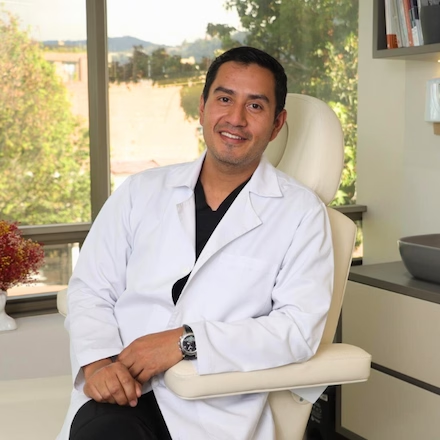
Reviewed by Dr. Oscar Barón · Cirujano plástico · SCCP
$475 USD
- Surgical facelift $7,000 USD
- Decided by Degree of laxity
Facial sagging is not treated the same at 38 as at 55. At 38, a radiofrequency or ultrasound treatment can tighten enough. At 55, with evident descent of cheeks and jowls, technology alone falls short. But between those two extremes there is a grey zone where the decision is not obvious.
This comparison between the surgical facelift and non-surgical treatments gives you the technical data to choose well.
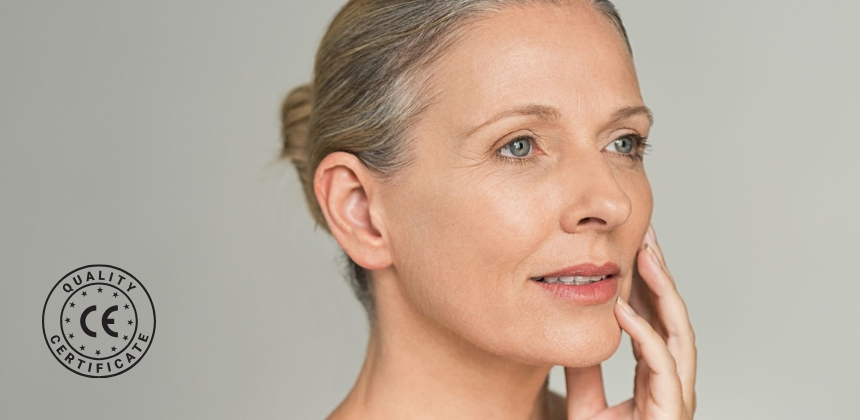
What each treatment does and how far it reaches
Surgical facelift (rhytidoplasty)
The facelift is surgery that accesses the SMAS plane (superficial musculo-aponeurotic system) to reposition the deep facial tissues. It does not just tighten skin — it reorganizes the structure that supports the face. It corrects cheek descent, deep nasolabial folds, moderate to severe jowls, marked marionette lines, excess skin on the neck and jaw, and loss of the cervicomental angle.
The result is equivalent to 8–12 years of rejuvenation, with a duration of 7–10 years before gravity produces significant changes again.
FaceTite: minimally invasive bipolar radiofrequency
FaceTite uses a cannula with bipolar radiofrequency that contracts fat tissue and skin from inside, under local anesthesia. It produces collagen contraction without visible incisions.
Its ideal territory is mild to moderate sagging of the lower facial third: early to moderate jowls, loss of jawline definition, and submental fat accumulation. Where the facelift reorganizes the deep structure, FaceTite contracts and remodels from the internal surface of the tissue.
The result is visible tightening with a natural effect that lasts between 3 and 5 years.
Morpheus8: fractional radiofrequency with microneedles
Morpheus8 combines microneedles with radiofrequency at controlled depths. Its mechanism is different: it stimulates collagen and elastin production by remodeling the dermis and subdermal tissue.
It is indicated for mild sagging, irregular texture, enlarged pores, acne scars, fine lines, and superficial wrinkles. It does not reposition tissues or remove excess skin — it improves the quality of what is already there.
The result is a progressive improvement in texture and firmness over 2–3 sessions, with a duration of 1–2 years per treatment cycle.
Liftera HIFU: microfocused ultrasound
Liftera emits focused ultrasound at different depths (1.5, 3.0, and 4.5 mm) to generate thermal coagulation points that contract tissues.
It works on mild sagging in cheeks and jawline, mild brow descent, early jowls, and generalized loss of firmness. Its effect is more subtle than FaceTite’s but requires no anesthesia and has no recovery period.
The result is a progressive lifting effect that reaches its peak at 3 months and lasts between 12 and 18 months.
Comparison table: facelift vs non-surgical treatments
| Factor | Facelift | FaceTite | Morpheus8 | Liftera HIFU |
|---|---|---|---|---|
| Anesthesia | General | Local + sedation | Topical + local | None |
| Duration | 3–5 hours | 1–2 hours | 30–60 min | 30–45 min |
| Incisions | Yes (periauricular) | Minimal (2–3 mm) | No | No |
| Social recovery | 2–3 weeks | 3–5 days | 2–3 days | Immediate |
| Post-procedure pain | Moderate | Mild–moderate | Mild | Minimal |
| Maximum result | 1–3 months | 3–6 months | 3 months | 3 months |
| Result duration | 7–10 years | 3–5 years | 1–2 years | 12–18 months |
| Degree of sagging | Moderate to severe | Mild to moderate | Mild | Mild |
| Price | $8M – $14M | $3.5M – $6M | $800K – $1.5M/session | $600K – $1.2M/session |
| Sessions | 1 | 1 | 2–3 | 1–2/year |
How to choose based on your degree of sagging
The most important variable is the degree of sagging. Not fear of surgery or budget — those are secondary. If sagging is severe, no non-surgical treatment will deliver a satisfactory result.
Mild sagging (grade I): prevention as strategy
The skin feels less firm to the touch, nasolabial folds are beginning to appear, and the jawline is slightly blurred. Usually presents between ages 35 and 45.
You do not need surgery. A Morpheus8 cycle (2–3 sessions) or an annual Liftera session maintains firmness. These are preventive treatments that delay the need for more invasive procedures by 5–10 years. The investment is modest and the impact on daily life is zero: no recovery, no disability.
Moderate sagging (grade II): the decision zone
Nasolabial folds are marked, cheeks have visibly descended, jowls are beginning, and the jawline has blurred. Typical age: 45–55 years.
This is where the decision gets complicated. FaceTite produces significant tightening without the scars or recovery of surgical lifting. In many cases, combined with Morpheus8 to improve texture, it achieves results that avoid or postpone surgery for 3–5 years.
For patients with moderate sagging who do not want or cannot commit to surgery, FaceTite is the closest alternative to a facelift — with the advantage of a 3–5 day recovery instead of 2–3 weeks.
Severe sagging (grade III): surgery as the only real transformation
Evident cheek descent, pronounced jowls, excess neck skin, loss of the cervicomental angle, and deep marionette lines. Typical from age 55 onward, or earlier in patients with genetic factors or massive weight loss.
When sagging involves real excess skin and significant descent of deep tissues, surgery is the only option that produces a transformative result. FaceTite or Liftera at this grade produce minor improvements that rarely justify the investment or meet patient expectations.

Can surgery and technology be combined?
Yes, and it is an increasingly common strategy in advanced facial rejuvenation.
Facelift + Morpheus8 (at 3–6 months post-surgery)
The facelift repositions deep tissues; Morpheus8 improves skin quality — texture, pores, tone. They are complementary treatments working on different layers. The combination produces a more complete result than either one alone.
Facelift + Liftera HIFU (annual maintenance)
Annual Liftera sessions after a facelift maintain the firmness of the result and extend its duration. It is the most widely used maintenance strategy to prolong the life of the facelift.
FaceTite + Morpheus8 (same day or sequential)
This combination is frequently performed in the same session. FaceTite contracts from within; Morpheus8 remodels the superficial dermis. Together they produce a “mini-lift” effect without surgery that satisfies patients with moderate sagging who want to avoid the operating room.
What technology cannot replace
There are clear limitations that no current technology overcomes.
Real excess skin is an absolute barrier. If there is hanging skin on the neck or cheeks, only surgery can remove it. Radiofrequency contracts existing tissue but cannot eliminate centimeters of redundant skin.
Severe tissue ptosis cannot be resolved with technology either. When the fatty compartments of the face have migrated downward, radiofrequency and ultrasound cannot reposition them. The facelift accesses the SMAS plane and fixes them surgically.
Marked platysmal bands in the neck require direct surgical suture, and significant facial asymmetry requires asymmetric, personalized correction that only surgery provides with precision.
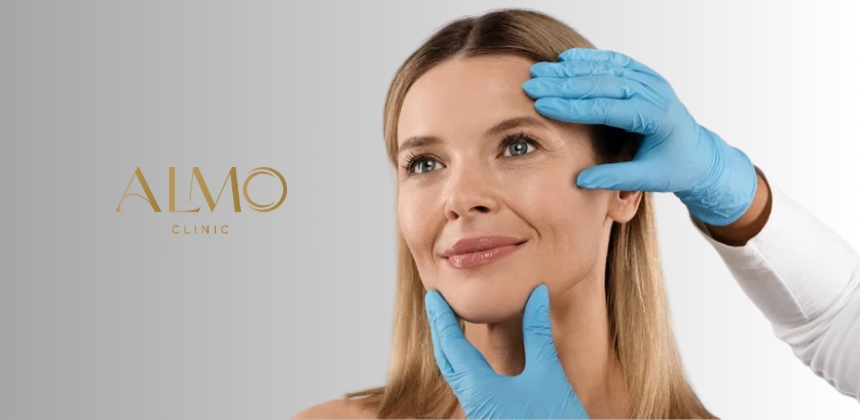
What surgery cannot replace
The facelift also has limitations that technology complements.
Skin quality does not improve with surgery. The facelift repositions but does not transform texture, pores, or pigmentation. For that, Morpheus8, CO2 laser, or specific topical treatments are needed.
Facial volume lost with age is not restored by a facelift. It is complemented with facial fat transfer or hyaluronic acid to restore fullness to cheeks, temples, and folds.
And long-term maintenance is beyond the facelift’s reach. Aging continues after surgery. Periodic non-surgical treatments — Liftera, Morpheus8, skin care — are what maintain and extend the result during the following decade.
10-year investment comparison
For a 50-year-old patient with moderate-to-severe sagging, the cumulative investment in each strategy is revealing.
| Strategy | 10-year investment | Cumulative result |
|---|---|---|
| Facelift (once) + annual Liftera | $10M – $16M + ~$8M = $18M – $24M | Surgical transformation + sustained maintenance |
| FaceTite every 4 years + annual Morpheus8 | $7M – $12M + ~$10M = $17M – $22M | Progressive improvement without surgery |
| Liftera + Morpheus8 annually only | ~$18M – $24M | Maintenance without real transformation |
For detailed Morpheus8 pricing, check our specialized page.
The cumulative cost at 10 years is surprisingly similar across the three strategies. The difference is not in investment but in the magnitude of the result: the facelift produces a transformation; non-surgical treatments produce maintenance and gradual improvement.
Frequently asked questions
Can I have FaceTite instead of a facelift if I am afraid of surgery?
If your degree of sagging is mild to moderate, FaceTite is a valid alternative. If it is severe, FaceTite will not produce the result you expect. Fear of surgery is understandable, but it should not be the determining factor — your anatomy should be.
At what age is a facelift recommended?
There is no minimum or maximum age. The indication is based on degree of sagging, not chronological age. There are 45-year-old patients with severe sagging due to genetics or weight loss, and 65-year-old patients with moderate sagging who benefit more from FaceTite.
How many times can you repeat a facelift?
A facelift can be repeated 1–2 times in a lifetime, with an interval of 8–10 years between procedures. Each time, the same SMAS plane is worked on. That is why it is important to complement with non-surgical treatments to prolong the result and reduce the need for reintervention.
Does a facelift leave visible scars?
Incisions are made within the preauricular fold, behind the ear, and along the hairline. At 3–6 months they are practically invisible. Surgical technique and post-operative scar care determine the quality of the outcome.
Can I start with non-surgical treatments and have the facelift later?
Yes, and it is the most common strategy. Many patients begin with Morpheus8 or Liftera at 40, add FaceTite at 48–50, and reach the facelift at 55–60 when sagging requires surgical intervention. Previous treatments do not compromise future surgery — in fact, arriving at the facelift with a treated, stimulated skin can improve results.
The right decision starts with a diagnosis
There is no universal treatment for facial sagging. The choice depends on your anatomy, your degree of sagging, your expectations, and your recovery availability.
At ALMO Clinic, your consultation includes a complete sagging analysis to recommend the most effective treatment — whether surgical or not. If a facelift is not necessary, we tell you. If it is, we explain why.
Schedule your specialist consultation </a>