In summary
Blepharoplasty is the surgery that removes excess skin, fat and muscle from the upper eyelids, lower eyelids or both. It differs from non-surgical treatments in that those may tighten skin slightly but cannot remove under-eye bags: those bags are herniated fat and are only corrected by removing or repositioning it. At ALMO Clinic in Bogotá two-eyelid surgery starts from $1,750 USD and four-eyelid surgery from $3,000 USD.
Reviewed by Dr. Oscar Barón · Plastic surgeon · SCCP
From $1,750 USD
- Four eyelids From $3,000 USD
- Social recovery 7–10 days
Eyelids age before the rest of your face. The skin there is the thinnest on your body — barely a millimeter — and it doesn’t have the same collagen density as other areas. The result: bags, excess skin, and drooping eyelids showing up before 50 in a lot of people.
Blepharoplasty is the surgery designed to fix exactly that. In this guide, we break down what it is, what it does, what it doesn’t do, and when it’s the right call.
What is blepharoplasty?
Blepharoplasty — also called eyelid surgery — is a surgical procedure that removes excess skin, fat, and in some cases muscle from the upper eyelids, lower eyelids, or both.
It doesn’t stretch the skin. It doesn’t pull artificially. It removes the tissue that doesn’t belong and reshapes the anatomy of the eyelid to bring back its natural, rested appearance.
It’s one of the most commonly performed cosmetic surgeries in the world, with decades of clinical evidence on its safety and effectiveness. According to the American Society of Plastic Surgeons, blepharoplasty consistently ranks among the top five most frequently performed surgical procedures globally.
What problems does it correct?
Blepharoplasty addresses two categories of issues: aesthetic and functional.
Aesthetic issues:
- Excess skin on the upper eyelid that creates a tired appearance
- Herniated fat bags under the eyes
- Lower eyelid with wrinkled or excess skin
- Asymmetry between eyelids caused by aging
Functional issues:
- Eyelid ptosis: when the upper eyelid falls over the iris and limits the visual field
- Excess skin so pronounced it interferes with peripheral vision
In functional cases, blepharoplasty isn’t just cosmetic — it’s a medical correction, and it should be documented with a visual field test before surgery is planned.
Upper vs. lower blepharoplasty: what’s the difference?
| Feature | Upper blepharoplasty | Lower blepharoplasty |
|---|---|---|
| Area | Upper eyelid | Lower eyelid |
| Problem corrected | Excess skin, drooping lid, visual impairment | Fat bags, structural dark circles, excess skin |
| Incision | In the natural eyelid fold | Just below the lash line |
| Duration | 45–60 minutes | 45–60 minutes |
| Visible recovery | 7–10 days | 7–10 days |

Both can be performed in the same surgical session — this is called a full or four-eyelid blepharoplasty.
How is the surgery performed?
Blepharoplasty is done under local anesthesia with sedation or general anesthesia, depending on whether one or both pairs of eyelids are treated and the patient’s preferences.
The surgeon marks the incision in the natural fold of the upper eyelid (where a fold already exists) and just below the lash line on the lower eyelid. Through that incision, they remove the excess skin, eliminate or redistribute the herniated fat, and if needed, adjust the tone of the orbicularis muscle.
Closure is done with fine sutures removed between day 5 and day 7. Total procedure time ranges from 45 minutes (single eyelid) to 2 hours (all four eyelids with laser technique).
Traditional technique vs. CO2 laser technique
In CO2 laser blepharoplasty, the conventional scalpel is replaced by a beam of light that cuts and coagulates simultaneously. The practical advantages: less bleeding during surgery, shorter recovery, and a scar that can be even finer.
The traditional scalpel technique remains valid and delivers excellent results, especially in more complex cases where the surgeon needs greater tactile control over the tissue. Choosing between them depends on the patient’s anatomy and the specialist’s judgment — not a hierarchy between techniques.
Who is a candidate for blepharoplasty?
The best way to find out is through a medical assessment. That said, there are clear signs that eyelid surgery is the right option:
- People tell you you look tired even when you’ve gotten plenty of sleep
- You use undereye concealer as a daily routine
- You feel your upper eyelids “weigh” or droop over your eyes
- Photos from 10 years ago show a clearly wider eye opening
- Non-surgical treatments you used before aren’t doing the job anymore
There’s no minimum age for blepharoplasty. The criteria is the condition of the eyelid, not the patient’s birth year.
When isn’t eyelid surgery enough on its own?
When brow descent contributes to the drooping eyelid look — which is common after 50 — blepharoplasty may need to be complemented with a brow lift to get a complete result. The surgeon identifies this in the preoperative assessment.
Similarly, if facial aging is generalized (descended cheeks, deep folds, loss of jaw definition), a facelift may be the most appropriate solution, with blepharoplasty as a complement.
Blepharoplasty vs. non-surgical alternatives: when to use each
Non-surgical periocular treatments have a real place, but they’re different tools with different results.
Juvelook, for instance, is a bio-stimulator that improves skin quality around the eye, hydrates, softens crow’s feet, and reduces superficial dark circles. It’s a solid option for mild sagging or as a maintenance complement. It doesn’t eliminate excess skin or structural fat bags.
AccuTite uses high-precision radiofrequency to contract tissue in small areas like the eyelid. It’s effective for mild sagging before real excess skin develops.
Once excess skin is visible or fat bags are structural, neither of these treatments removes them. Blepharoplasty is the only definitive solution.
Results: what to expect and how long they last
Results are visible within the first few weeks, once the initial swelling goes down. The final result is appreciated between 3 and 6 months.
A well-executed blepharoplasty lasts between 8 and 12 years. That doesn’t mean the eyelids return to their pre-surgery state after that time — aging continues, but from a much better baseline. Many patients never need a second procedure.
What doesn’t change over time: the recovered eye opening, the elimination of fat bags, and the improved quality of the look.
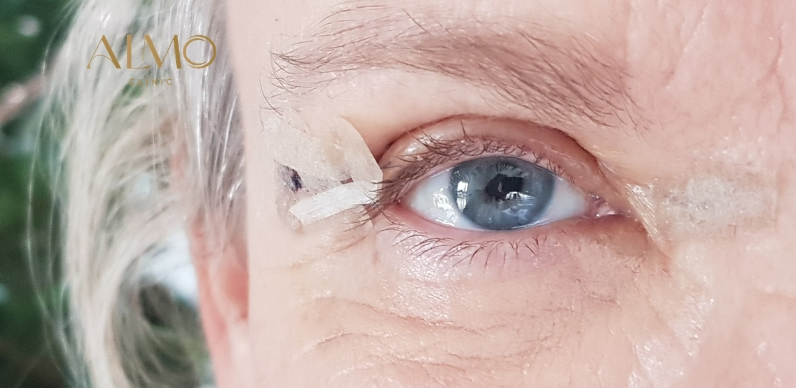
If you recognize the symptoms described in this article, the next step is an assessment with a board-certified plastic surgeon. At ALMO Clinic, we evaluate your eyelid condition, explain which type of blepharoplasty fits your case, and provide a complete quote with no commitment.
See all the details about the surgery →
Want to know if surgery or a non-surgical alternative fits your eyelids best? Ask our medical team directly.
Ask about your blepharoplasty case </a>