
SCCP-certified surgeons
Our surgical team specializes in 360° liposculpture, combining donor-zone extraction with recipient-zone volume redistribution.
ALMO Clinic's liposculpture approach goes beyond simple fat removal: our SCCP-certified surgeons apply a 360-degree artistic framework that balances extraction zones with strategic fat grafting to create proportionate, natural-looking contours. Patients are carefully screened to confirm they are candidates for reshaping, not weight reduction.

5.0/5 on 15 Google reviews
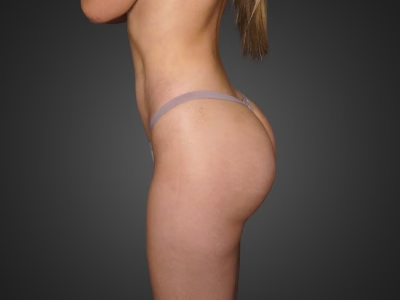
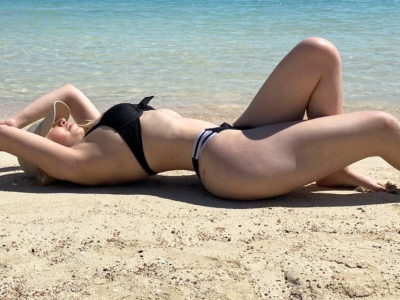
Liposuction removes fat from localized deposits. Liposculpture goes further: it removes fat, processes it and reinjects it where volume is needed, so it reshapes proportion instead of only subtracting. In Colombia at ALMO Clinic it starts from $1,500 USD for a single area, with full 360° circumferential liposculpture from $4,125 USD. The compression garment is worn 4 to 6 weeks and the final contour appears at 3 to 6 months.
Reviewed by Dr. Oscar Barón · Cirujano plástico · SCCP
Our surgical team specializes in 360° liposculpture, combining donor-zone extraction with recipient-zone volume redistribution.

Extracted fat is processed in a closed system to maximize graft viability, following a strict fat-embolism prevention protocol.

Patients are monitored from the first days of active rest through the final contour result at three to six months.
The distinction between liposuction and liposculpture matters clinically. Liposuction is an extraction procedure — fat is removed from excess zones and discarded. Liposculpture adds a transfer component: extracted fat is processed to isolate viable adipocytes, then reinjected into recipient zones where volume is deficient. Abdomen and flanks are sculpted while buttocks or hips gain projection. The procedure reshapes overall body architecture, not just reduces individual zones.
Colombia has built one of the strongest international reputations in liposuction and body contouring technique — a product of surgical volume, training, and the specific aesthetic demands of the South American market. At ALMO Clinic, SCCP-certified surgeons perform liposculpture at prices 60–75% below equivalent US procedures, without any reduction in surgical standards or implant quality.
The surgical plan defines extraction zones and transfer zones based on each patient's body goals and available anatomy
The most frequent donor zones are the abdomen, flanks, lower back, inner and outer thighs, upper arms, and submental area (chin). The choice of donor sites serves two purposes simultaneously: removing localized fat deposits improves the donor area while generating the material needed for transfer. In 360° liposculpture, the full circumference of the trunk — abdomen, flanks, and back — is treated in a single surgical session.
Extracted fat can be transferred to the buttocks for natural volume augmentation (BBL), the hips to enhance lateral projection, the breasts for modest natural volume increase (less than one cup size), or the face for facial rejuvenation. The recipient zone largely defines the technique and surgical plan — a BBL and a hip augmentation require different injection depths, volumes, and positioning protocols.
The ideal liposculpture candidate has maintained stable weight for at least 3–6 months, has acceptable skin tone that allows retraction after fat extraction, and has localized fat deposits in specific zones that are unresponsive to diet and exercise. BMI between 22 and 32 is typically the workable range. The goal is contour redefinition, not weight loss — a realistic expectation of this distinction is essential to a good outcome.
Liposculpture is contraindicated in patients with obesity (BMI above 35), uncompensated cardiovascular disease, coagulation disorders, or uncontrolled diabetes. In patients with very lax skin, fat extraction without skin resection may worsen the appearance — these patients may be better candidates for abdominoplasty or a combination procedure. Very lax skin with localized fat may benefit from BodyTite (radiofrequency-assisted liposuction) which adds a skin-tightening component not available in conventional liposculpture.
| Feature | Surgical liposculpture | BodyTite (radiofrequency) |
|---|---|---|
| Anesthesia | General | Local + sedation |
| Recovery | 2–3 weeks | 3–5 days |
| Skin tightening | Depends on pre-existing skin tone | Active RF-driven retraction |
| Fat volume extracted | Higher — suited for larger volumes | Lower — suited for moderate volumes |
| Fat transfer capability | Yes — for BBL and other zones | No |
5.0 · 15 reviews on Google
ALMO is more than excellent. From the moment you arrive, the care they offer, the warmth and empathy add to the valuable and wonderful experience with their professionals, especially with Dr. Oscar Barón, a human being with very special ethical and professional values…
The best clinic in Bogotá. Dr. Andrés Parra answered all my questions about the procedure, and I'm happy with the results — highly recommended!
My experience was extremely satisfying. I found a very professional team, led by Dr. Martha Peñarredonda, to whom I am deeply grateful. I always felt supported, and everything was clear and well explained…
Very good care. Dr. Oscar Barón is an excellent surgeon, and Yohana's attention was the best. Very happy with the service I received.
Dr. Parra is the best in the city! I recommend him 100%.
Video call with your surgeon to map the treatment zones, define the extraction and transfer plan, and receive a complete price quote before booking your trip.
Schedule liposculpture consultation