
Personalised facial design
Dr. Oscar Barón designs the beard pattern together with the patient, respecting the natural direction of facial hair.
A successful beard transplant requires precise mastery of follicle angulation — each graft must exit the skin at the same oblique angle as native facial hair to blend seamlessly. ALMO Clinic's trichology surgeons plan every recipient site individually, matching natural growth direction zone by zone across the jawline, mustache, and cheeks.

5.0/5 on 15 Google reviews
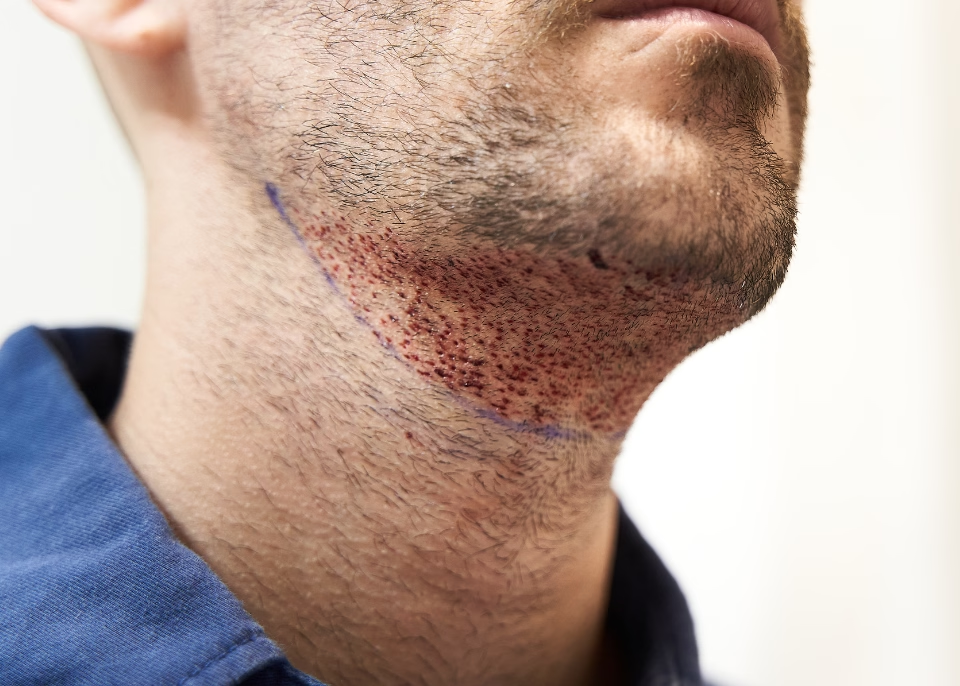
A beard transplant grafts follicles from the nape into areas without facial hair, following the near-parallel angle at which beard hair naturally grows. That angle is what determines whether the result looks natural: implanted at the wrong inclination, hair grows away from the face. It is permanent, because nape follicles keep their genetic resistance to hair loss. At ALMO Clinic in Bogotá it is quoted according to the number of follicles required.
Reviewed by Dr. Oscar Barón · Plastic surgeon · SCCP
Dr. Oscar Barón designs the beard pattern together with the patient, respecting the natural direction of facial hair.

We use direct implantation to reproduce the exact hair angle on the cheeks, chin and sideburns.

We follow the evolution of the transplanted hair up to the final review that confirms the definitive result.
Beard hair does not grow vertically. On the cheeks it exits almost parallel to the skin; on the chin it is more perpendicular; on the sideburns it follows its own angle. If the surgeon does not reproduce that pattern precisely during implantation, the result shows.
At ALMO Clinic we use the DHI technique with the Choi implanter for the beard transplant, because it is the technique that offers the greatest control over the angle and direction of each implanted hair. The beard pattern design is done with the patient before the procedure.
"The beard is one of the most demanding transplants in terms of naturalness. Not because it is technically difficult, but because any irregularity in the angle or direction of the hair is noticed immediately. That is why the prior design and the DHI technique are essential." — Dr. Óscar Barón, Plastic Surgeon Certified by the SCCP.Book your beard assessment
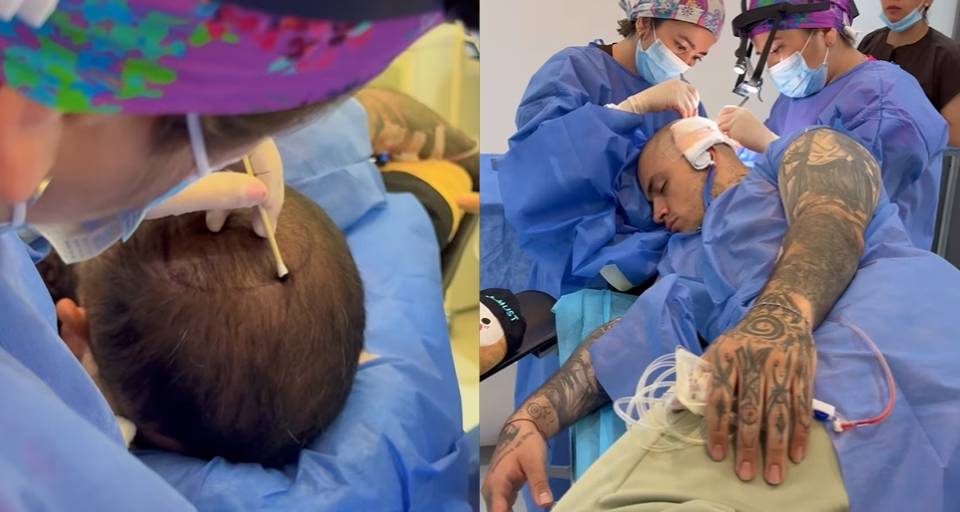
The absence or scarcity of hair in the beard zone can have several causes, all of them treatable with a beard transplant once stabilised:
The most common cause. Many men have naturally sparse areas on the cheeks, chin or sideburns without any underlying disease. The transplant permanently densifies those areas with the patient's own hair.
Alopecia areata can affect the facial area, leaving circular or oval bald patches in the beard. Once the disease is controlled and the patches have been stable for at least 12 months, the transplant repopulates the affected zones.
Accidents, burns or surgeries in the facial area can locally destroy the follicles, interrupting the continuity of the beard. The transplant can cover those scarred zones with real hair.
The beard transplant at ALMO Clinic is performed with the DHI direct-implantation technique, which makes it possible to control the angle and direction of each implanted hair with millimetric precision.
Diagnostic consultation where we analyse the current distribution of the beard, the zones to densify or reconstruct, and design together the desired result. Prior planning is essential to achieve the beard pattern the patient envisions.
Under local anaesthesia, the follicles are extracted from the nape donor area with precision micro-punches. Single- and double-hair units are preferentially selected according to the beard zone to cover (finer in contour zones, denser in the interior).
Each follicle is implanted with the Choi pen respecting the natural angle of the beard hair in each zone. The process is outpatient and performed in a single session of 3–5 hours depending on the number of follicles.
The beard transplant is not a single treatment with a single patient profile. Depending on the starting situation, the procedure is oriented towards one of three different objectives.
For patients who have a beard but with sparse areas, especially on the cheeks or between the moustache and the beard. Between 500 and 1,500 follicles are transplanted to even out the density and complete the appearance of a full beard.
For stabilised alopecia areata in the beard or scars from trauma and surgery. The transplant repopulates the affected zones with the patient's own hair, restoring the continuity of the beard.
For patients with very little or no facial hair due to genetic predisposition. It requires between 2,000 and 3,500 follicles and is planned in detail to create a beard pattern coherent with the patient's features.
The hair transplanted into the beard is permanent: the implanted follicles do not fall out once established. There is no maintenance treatment for the procedure: the transplanted beard grows and behaves like real hair, because it is.
The only maintenance is the usual shaving or trimming of the beard, which may be slightly more frequent at first since scalp hair can grow somewhat faster than native beard hair. This rhythm tends to normalise over time.
At 12–18 months after the transplant, the beard has reached its definitive result. At that point we carry out the final evaluation and, if the patient wishes, we can plan a second refinement session to add more density in specific zones.
Many patients who have a beard transplant also consider an eyebrow transplant. Both procedures can be planned together or in separate sessions, optimising the use of the donor area and designing a coherent facial balance between the two results.
The beard and eyebrow treatments are also complemented by the DHI hair transplant, which uses the same direct-implantation principles for the scalp.