
Certified trichology surgeons
The FUE transplant is performed by surgeons with specific training in hair surgery, not technicians or aestheticians.
The FUE hair transplant is the most advanced procedure for restoring hair density permanently. At ALMO Clinic it is performed by certified trichology surgeons with state-of-the-art equipment.

5.0/5 on 15 Google reviews
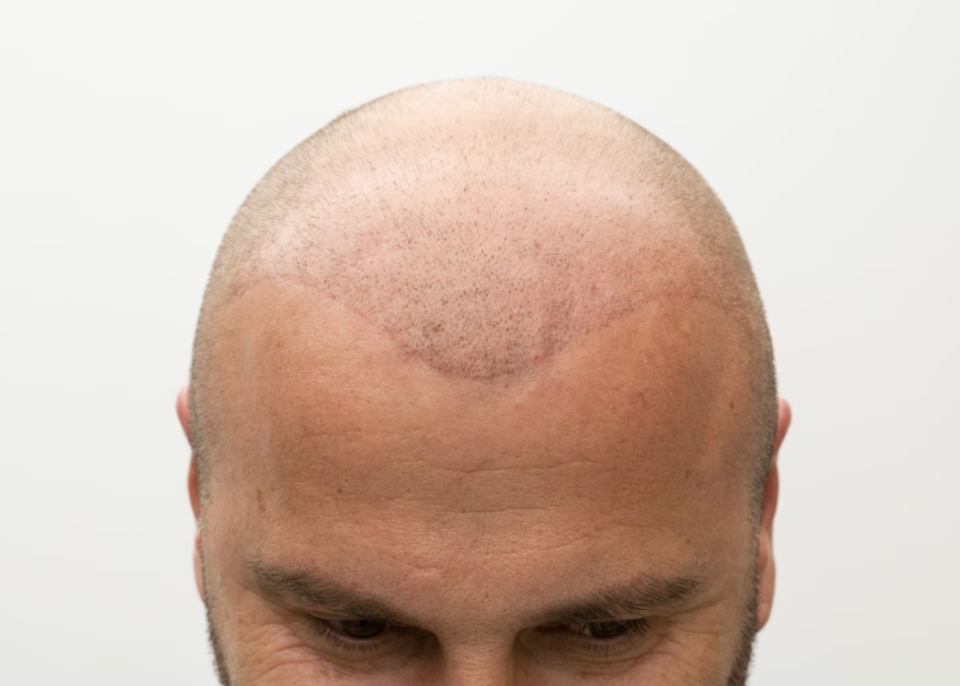
The FUE (Follicular Unit Extraction) technique removes each follicle individually from the donor area with a precision micromotor, without excising a strip of scalp as the older FUT method does. That is why it leaves no linear scar, only millimetric dots that disappear as hair grows. At ALMO Clinic in Bogotá it starts from $1,125 USD for 1,000 to 2,000 follicles, from $1,875 USD for 2,001 to 3,000, and from $2,500 USD above 3,001.
Reviewed by Dr. Oscar Barón · Plastic surgeon · SCCP
From $1,125 USD
The FUE transplant is performed by surgeons with specific training in hair surgery, not technicians or aestheticians.

We use 0.7 to 1 mm instruments that minimise follicular trauma and maximise graft survival.

We schedule reviews at one, 3, 6 and 12 months to follow the growth of the transplanted hair.
A hair transplant does not begin in the operating room. It begins with an honest assessment of the donor area: how many follicles are available, what their calibre is, how density is distributed and what will happen to the native hair over the coming years.
If the donor area is not sufficient to meet the patient's expectations, we say so before scheduling anything. Because a transplant planned on an inaccurate diagnosis can deliver a disappointing result, and that is the most common mistake we see in second opinions.
"The most frequent mistake I see in second opinions is the transplant performed without properly analysing the donor area. The patient wanted 4,000 follicles, there were 1,800, and no one told them clearly. The prior diagnosis is not a formality: it is the most important part of the procedure." — Dr. Óscar Barón, Plastic Surgeon Certified by the SCCP.Book your trichological assessment
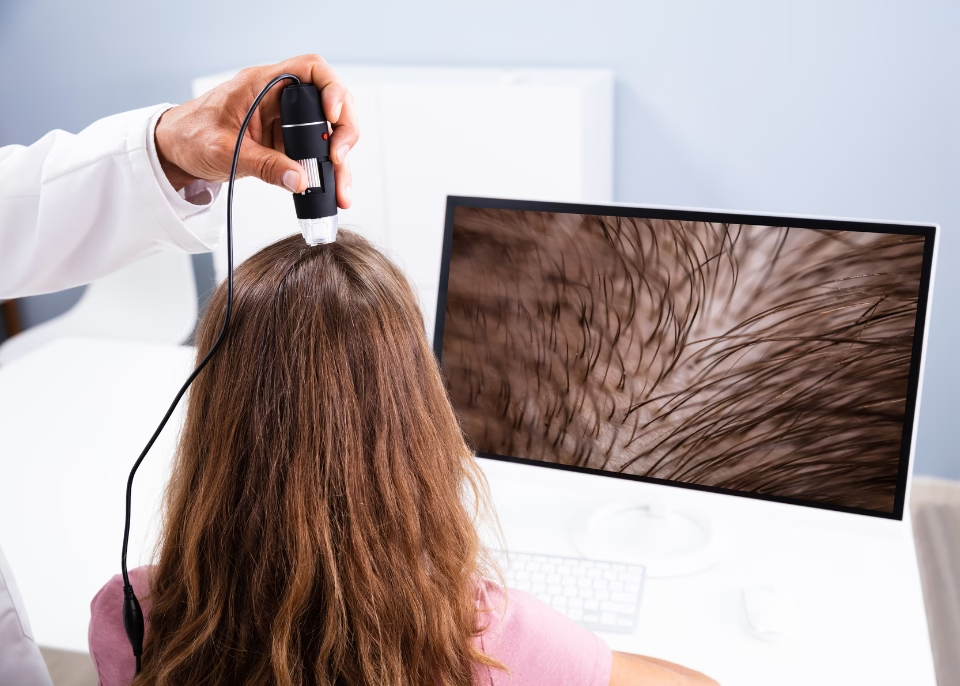
At ALMO Clinic the FUE hair transplant is performed by trichology surgeons with specific training in hair surgery — not technicians or aestheticians. Each session is planned from the trichoscopic diagnosis: we analyse the donor-area density, the angle and direction of the native hair, and we project the design of the new hairline together with the patient before beginning any procedure.
We use 0.7 to 1 mm precision punches to minimise follicular trauma and maximise graft survival. Implantation is performed with manual and optical control to respect the natural direction of the hair in each zone.
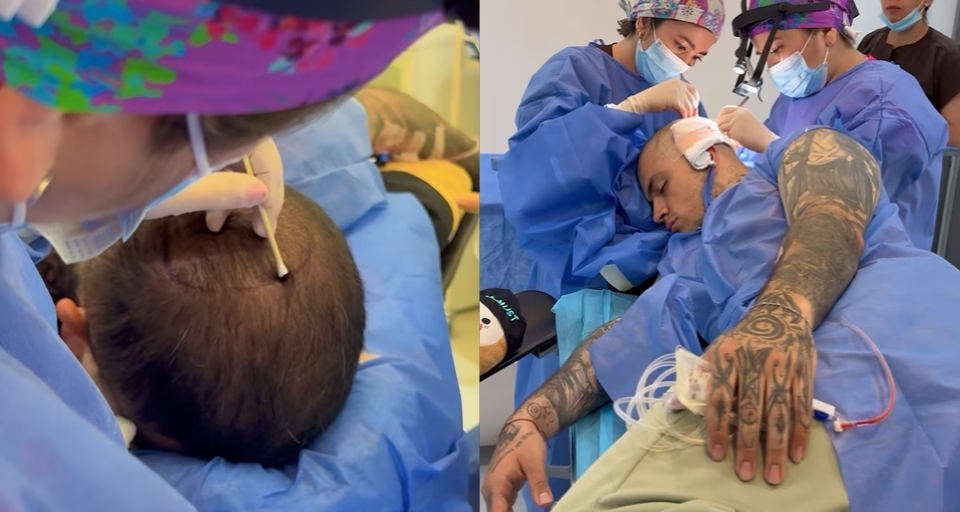
The FUE transplant is an outpatient surgery performed under local anaesthesia. It requires no hospitalisation and the patient returns home the same day.
Diagnostic consultation with a digital trichoscope. We analyse the density and quality of the donor area, the degree of alopecia (Norwood scale) and design the hairline and treatment zones together.
With the donor area shaved, the surgeon extracts each follicular unit individually with precision micro-punches. The follicles are preserved in physiological solution at a controlled temperature to maintain their viability.
Micro-incisions are made in the recipient area respecting the angle, direction and natural density of the existing hair. This phase largely determines the final aesthetic result.
The extracted follicles are inserted one by one into the recipient channels, ensuring correct orientation. Single-hair follicular units are placed along the hairline; 2–3 hair units in the higher-density rear zones.
Light dressings are applied at the end. The same day the patient receives detailed post-operative care instructions. The first 72 hours are critical for the correct implantation of the follicles.
We carry out reviews at one month, 3 months, 6 months and one year. The definitive result is assessed between months 12 and 18 post-procedure, when the hair has reached its full density and thickness.
Both techniques extract and transplant individual follicular units. The decision depends on each patient's profile, not on a hierarchy of quality.
| Criterion | FUE technique | DHI technique |
|---|---|---|
| Donor-area shaving | Full shave | Partial shave possible |
| Implantation | Pre-opened channels + later insertion | Simultaneous opening and insertion with Choi |
| Control of angle and direction | Very good | Excellent (especially for eyebrows and beard) |
| Follicles per session | Up to 4,000 | Up to 3,500 (slower process) |
| Coverage density | High | Very high in small areas |
| Preferred indication | Extensive balding, large volumes | Refinement, hairline, eyebrows, beard |
| Permanent result | Yes | Yes |
For a personalised assessment of which technique is most appropriate in your case, book a trichological consultation at ALMO Clinic.
The permanence of the FUE transplant is not a marketing promise: it is biology. The follicles extracted from the nape and temples are genetically different from the follicles on the top of the head that go bald with androgenetic alopecia.
Androgenetic alopecia occurs because dihydrotestosterone (DHT) miniaturises the follicles of the frontal zone and crown. The donor follicles at the nape do not have that sensitive receptor, and when transplanted into balding zones they keep that genetic characteristic for life.
The survival rate of follicles transplanted in a well-executed procedure exceeds 90%. The most critical factor is minimising the time the follicles remain outside the body: we work with preservation solutions and controlled extraction–implantation times.
The transplant is permanent, but it does not stop the alopecia of the hair that was not transplanted. That is why in many cases we complement it with PRP or medication to protect the existing native hair long term.
Recovery after an FUE transplant is progressive and largely asymptomatic. These are the main milestones:
Mild swelling in the donor and recipient areas that resolves spontaneously. Small crusts in the implantation zone that fall off on their own between days 7 and 10. Getting the head wet and touching it is avoided.
The transplanted hairs fall out. This is a normal and expected process: the follicle remains alive beneath the skin. This phase worries many patients but is a sign that the procedure was performed correctly.
The first new hairs appear. They are fine at first and gain thickness week by week. At month 6 between 50 and 60% of the final result can be appreciated.
The hair progressively gains density, thickness and texture. This is the period of greatest visible transformation for the patient.
At 12–18 months the transplanted hair has reached its full thickness and density. This is the result that will remain for life, since the implanted follicles are genetically resistant to balding.
Avoid direct sun exposure for the first 3 weeks. Do not perform high-intensity exercise during the first 2 weeks. Complement with hair mesotherapy or PRP to protect the native hair.
The FUE transplant restores the balding zones. To protect the existing native hair and optimise the scalp environment, we combine the transplant with these treatments:
PRP applied on the same day as the transplant provides autologous growth factors that accelerate the vascularisation of the transplanted follicles, improving survival and bringing forward the appearance of initial growth.
Pre-operative mesotherapy optimises the scalp and native follicle before surgery. Post-operatively, it reinforces the existing follicles surrounding the transplanted zone and prevents shock loss of the native hair.
Oral finasteride or dutasteride act on systemic androgenetic alopecia and protect the non-transplanted follicles. The ALMO medical team assesses their suitability according to each patient's profile.
Before any procedure, we perform a complete trichological assessment: digital trichoscope, donor-area analysis, study of the hair-loss pattern and projection of the possible result based on the number of available follicles.
Not all patients are ideal candidates for an FUE transplant. If the donor area does not have sufficient density, or if the alopecia is still actively progressing, we say so clearly and propose the most appropriate plan.
Diagnostic honesty is part of the ALMO standard.