
Personalised prior design
We map out the shape, density and symmetry of both eyebrows together with you before starting the procedure.
The eyebrow transplant permanently restores the density and shape of sparse eyebrows, those with scars from over-plucking, alopecia or irregularities. A natural result that lasts for life.

5.0/5 on 15 Google reviews
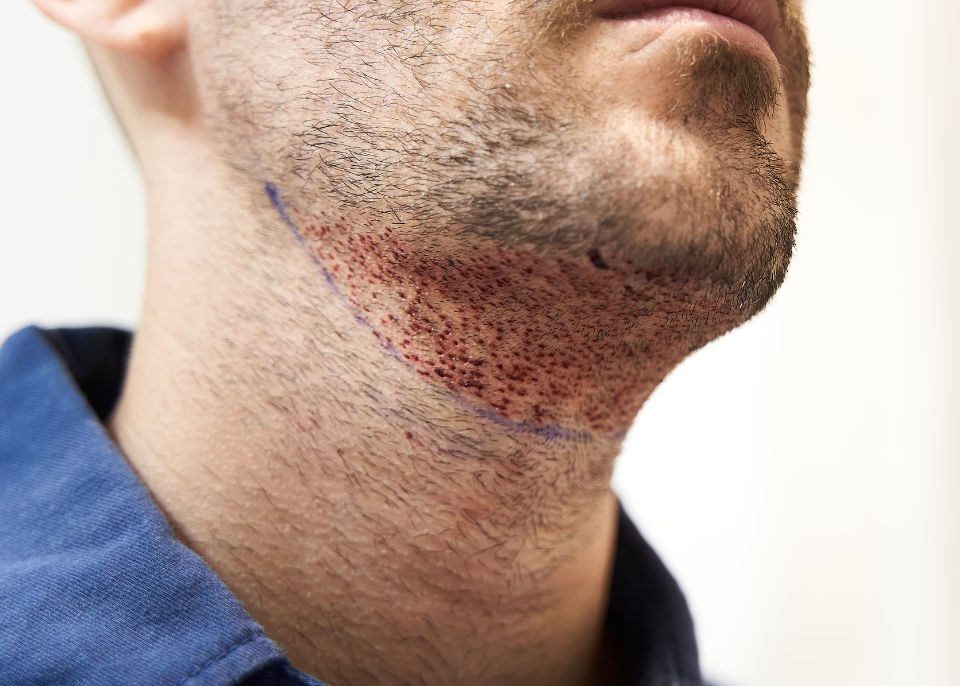
An eyebrow transplant grafts follicles from the nape — whose calibre is similar to eyebrow hair — following a pre-designed arch. Because that hair keeps the genetics of the donor area, it continues growing like scalp hair and needs periodic trimming. It is the permanent solution for eyebrows that no longer regrow after years of plucking, alopecia areata or scarring. At ALMO Clinic in Bogotá it starts from $875 USD.
Reviewed by Dr. Oscar Barón · Plastic surgeon · SCCP
We map out the shape, density and symmetry of both eyebrows together with you before starting the procedure.

The Choi implanter controls the exit angle of each follicle to mimic the eyebrow's natural growth.

We evaluate the evolution of the transplanted hair at every stage until confirming the definitive result at twelve months.
Eyebrows do not grow vertically. At the tail they grow almost horizontally outwards; in the body they tilt upwards; at the head they fan out. If follicles are transplanted at the wrong angle, the eyebrow looks "off" even if there is enough density.
That is why at ALMO we use the Choi implanter for eyebrow implantation: it allows the exit angle of each hair to be controlled with a precision that is not possible with conventional channel opening. The prior design of the eyebrow pattern, done with the patient awake, is the other half of the result.
"What surprises patients most is not that hair grows on their eyebrows — it is that the people around them do not realise they had a transplant. That is the real goal: a result that no one identifies as surgical." — Dr. Óscar Barón, Plastic Surgeon Certified by the SCCP.Book your eyebrow assessment
It is the question almost every patient asks before deciding. The answer depends on what you are looking for: a temporary result or a permanent one.
| Criterion | Eyebrow transplant | Microblading / Tattoo |
|---|---|---|
| What is implanted | Real hair follicles | Pigment in the skin |
| Result | Your own hair that grows naturally | Visual simulation of hair |
| Permanence | Definitive (no touch-ups) | 6–18 months (requires touch-ups) |
| Tactile appearance | Real hair, natural texture | Pigment on skin (no actual hair) |
| Maintenance | Periodic trimming of the hair | Touch-ups every 6–12 months |
| Indication | Sparse, hairless or patchy eyebrows | Shaping and colouring eyebrows that have hair |
| Recovery process | Result visible at 6–12 months | Result visible within a few days |
Microblading cannot replace real hair when there are areas with a total absence of hair. The transplant can, and with a result that requires no renewal.
The eyebrow transplant is indicated in different clinical situations. These are the most common causes we treat at ALMO Clinic:
Repeated plucking over years can irreversibly damage the follicle. When hair stops growing in systematically plucked zones, only a transplant can restore that density.
Alopecia areata can affect the eyebrows independently of the scalp, leaving characteristic oval bald patches. Once the disease is stabilised, the transplant restores the affected zone.
Accidents, burns or previous surgeries in the supercilliary area can locally destroy the follicles. The eyebrow transplant repopulates the scarred tissue with the patient's own hair.
Chemotherapy and radiotherapy can cause loss of eyebrows, which in some patients does not fully recover when treatment ends. The transplant offers a definitive solution once the therapy is complete.
Many patients simply have thin eyebrows from the start. There is no disease or injury: it is a genetic characteristic that the transplant can permanently change.
Differences in shape, density or position between the two eyebrows that make-up does not adequately compensate. The transplant corrects the asymmetry with real hair in the deficient zones.
The eyebrow transplant is performed with the DHI technique (direct implantation), which offers the greatest control over the hair's exit angle — a critical aspect for natural-looking eyebrows.
With the patient awake, we draw the design of both eyebrows together: shape, extent, density and symmetry. The prior design is essential to ensure a result that complements the patient's features.
The follicles are extracted from the nape donor area, where the hair calibre is most similar to that of the eyebrows. Single-hair units are preferentially selected for a natural-density result.
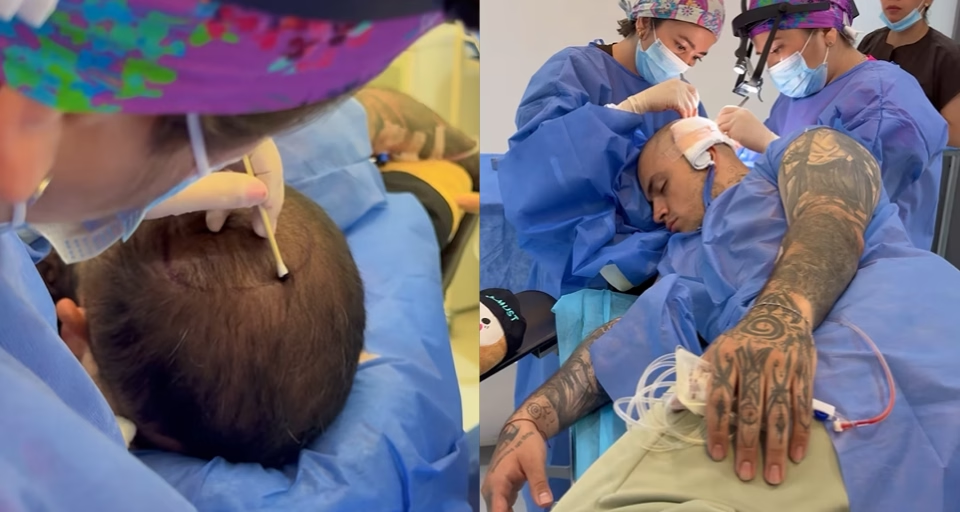
Each follicle is implanted with the Choi implanter at the exact angle of the natural eyebrow — very acute, almost parallel to the skin — and in the growth direction of each zone (tail, body, head). This technical detail is what determines the naturalness of the result.
Microblading loses intensity and tattoos change colour. The eyebrow transplant has no expiry date: the implanted follicles are permanent because they are yours.
Each transplanted follicle produces real hair of natural calibre, texture and light reflection. The eyebrow becomes three-dimensional — it is not an illusion drawn on the skin, it is hair that grows.
The donor-area follicles are not subject to androgenetic alopecia. Once implanted in the eyebrows, they keep that characteristic: they do not fall out again, nor do they require maintenance treatments of the transplant.
The transplanted hair grows on the hair cycle and may require periodic trimming. That is all. No touch-ups, no renewals, no recurring cost of the procedure.
The eyebrow transplant has a simple recovery, although it requires attention during the first few days to maximise the survival of the implanted follicles.
For the first 5 days, directly wetting the area and touching the small crusts that form is avoided. Between days 7 and 10 the crusts fall off on their own. Between weeks 2 and 4 the transplanted hairs shed (shock loss, normal and expected). Real growth begins from month 3. At 6 months 60–70% of the definitive result is visible, and the final evaluation is performed one year after the transplant.
Once the result is established, the transplanted eyebrows grow like normal hair and require periodic trimming to maintain the desired shape.