
SCCP-certified surgeons
Our surgical team has specific experience treating massive weight-loss patients and coordinates directly with your bariatric team.
After massive weight loss, patients face a distinct reconstructive challenge: redundant skin at multiple anatomical zones that requires carefully sequenced procedures rather than a single operation. ALMO Clinic's team prioritises patient safety through staged planning, minimum interval requirements between procedures, and nutritional readiness assessment before any case is scheduled.

5.0/5 on 15 Google reviews
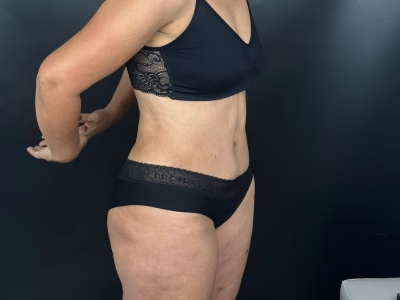
Post-bariatric surgery removes the excess skin and soft tissue left after major weight loss, whether from bariatric surgery or diet. It is not one operation but a staged plan, because several areas are usually involved. In Colombia at ALMO Clinic, brachioplasty starts from $3,000 USD, thigh lift from $3,500 USD and circumferential body lift from $7,500 USD. Weight must be stable for at least 6 months before operating.
Our surgical team has specific experience treating massive weight-loss patients and coordinates directly with your bariatric team.

Each procedure is sequenced around your weight stabilization timeline and nutritional readiness, not a fixed protocol.

Virtual consultations at weeks 2, 4, 8, and 12 monitor healing and prepare you for the next stage.
Bariatric surgery and significant weight loss represent extraordinary achievements — changes that transform long-term health outcomes. But human skin has a finite retraction capacity. When a large volume of adipose tissue is lost within a relatively short period, the resulting excess skin does not retract on its own. The outcome is folds of redundant skin at the arms, abdomen, thighs, buttocks, and breasts that interfere with hygiene, produce chronic skin irritation and intertrigo, and limit freedom of movement in ways that undercut the quality-of-life gains that weight loss was supposed to deliver.
Post-bariatric body contouring resolves this. It is not a cosmetic procedure in the conventional sense — it is a reconstruction of body contour that restores the functionality and quality of life of a patient who has already done the hardest work. At ALMO Clinic, SCCP-certified surgeons plan these procedures in stages calibrated to your nutritional status, weight stability, and surgical priorities.
The plan is individualized based on affected zones, excess skin volume, and the patient's health status and priorities
Removes excess skin from the inner arm from axilla to elbow. For post-bariatric patients, this is frequently the procedure with the greatest functional impact — excess arm skin limits movement, produces friction irritation, and makes normal clothing unwearable. The scar runs along the inner arm; with proper care it fades progressively over 12–18 months.
Addresses excess skin not only on the anterior abdomen but around the full trunk circumference — abdomen, flanks, and lower back. The procedure removes the "apron" or pannus of excess abdominal skin typical of post-bariatric patients while simultaneously lifting the buttocks and upper thighs. The most extensive single procedure in the post-bariatric program, typically planned as Stage 1.
Resects excess skin from the inner thighs. Resolves chafing during walking, chronic skin irritation, and aesthetic concerns in the zone. The scar is positioned in the inguinal crease and along the inner thigh. Specific hygiene attention is required in recovery because the inguinal scar position is vulnerable to maceration.
Weight loss causes breast ptosis (drooping) through loss of glandular volume. Mastopexy repositions the areola-nipple complex and removes excess skin. When there is severe volume deficit, implants can be combined with the lift. This procedure addresses both shape restoration and significant ptosis that non-surgical approaches cannot correct.
Surgical safety depends on arriving at the procedure in optimal conditions
Weight must be stable for at least 6 to 12 months. An actively declining weight makes the surgical result temporary — skin removed when weight is still falling will be replaced by additional skin laxity as more weight is lost. A letter from your bariatric or internal medicine team documenting weight stability is part of pre-surgical assessment. Reaching your target weight before surgery, not after, is the correct sequence.
Bariatric surgery can create significant deficits in protein, iron, vitamin B12, vitamin D, and zinc — all essential for wound healing. Before body contouring, complete labs are required and identified deficits must be corrected. Low albumin or protein levels significantly increase wound complication rates. Post-bariatric patients frequently need 3–6 months of nutritional optimization before body contouring surgery is safe.
Share your photos and weight loss history. Your surgeon defines the staged plan, priorities, and complete pricing — before you book your flights.
Schedule post-bariatric consultation