Dedicated postoperative team
Your surgical team monitors every stage of recovery and responds immediately if warning signs like fever or bleeding appear.
Complete rhinoplasty recovery guide. Real day-by-day and month-by-month schedule, postoperative care, alarm signals and when the final result is seen. Based on current clinical protocols.

5.0/5 on 15 Google reviews
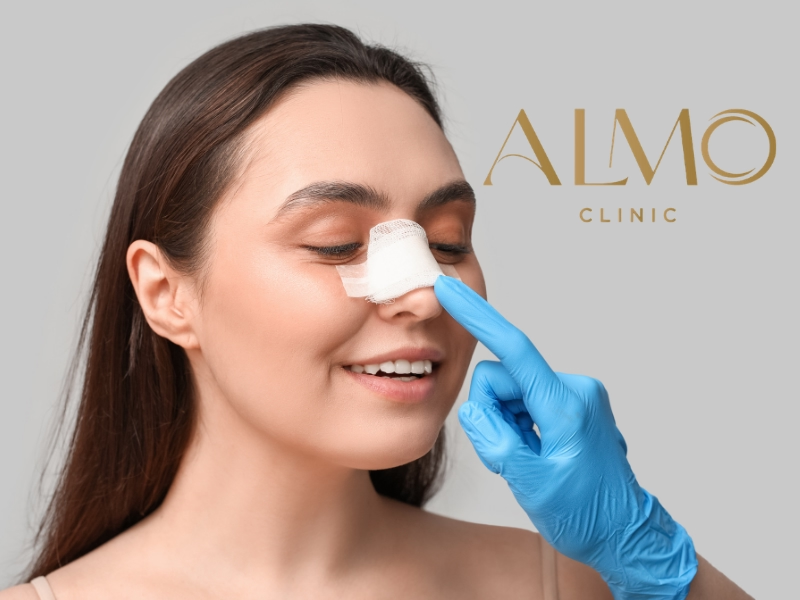
Social recovery after rhinoplasty takes 10 to 14 days, which is when the splint comes off and visible swelling subsides. Desk work resumes in week 2 and moderate exercise between weeks 4 and 6. Glasses must not rest on the nasal bridge for 6 weeks. The definitive result takes up to 12 months: the nasal tip is the last area to fully deswell.
Reviewed by Dr. Oscar Barón · Plastic surgeon · SCCP
Your surgical team monitors every stage of recovery and responds immediately if warning signs like fever or bleeding appear.

Our approach allows normal nasal breathing from day one, with the external splint removed between days 8 and 20.

Swelling resolves gradually as the nasal tip settles, with the definitive result confirmed between 6 and 12 months.
The nose operated on day 3 is not the nose you'll have month 6. That generates panic in many patients who don't know it. Swelling makes the nose look bigger, wider, and with bruises around the eyes — exactly the opposite of what they expected.
Rhinoplasty recovery has two very different phases. The first, 10 to 14 days, is visible adaptation: swelling, bruises, splint, and oral breathing. The second, silent, can extend up to 12 months while deep tip swelling gradually disappears. Understanding this avoids panic and impatience.
One of the most frequent questions in postoperative controls is: "Why does the tip still look the same?". The answer is that the nasal tip concentrates more soft tissue and has less circulation than the dorsum, so its swelling takes longer to resolve — especially in thicker skin.
The dorsum usually shows its final result by month 3. The tip, between months 6 and 12. Knowing this in advance makes postoperative controls tranquil rather than anguishing.
"To my patients I always say: month 1 photos are yours but not your result. The real result arrives when you stop looking for changes in the mirror every morning." — Dr. Óscar Barón, Plastic Surgeon.Schedule your rhinoplasty evaluation
The first 7 days are the most intense of the postoperative period
| Day | What's normal | Allowed activity | Care |
|---|---|---|---|
| Day 1 | Recovery exit. Anesthesia resolving. Nasal splint in place. No nasal packing: patient breathes through the nose from day one | Total rest. Mandatory companion first 24 h | Head elevated 45°. Don't blow your nose. Avoid physical effort |
| Days 2-3 | Maximum swelling. Periorbital bruises (blue/purple). Mild nasal dripping. Pressure sensation | Get up to bathroom and eat. Short walks at home | Cold compress on forehead and cheeks (not on nose). Soft diet |
| Days 4-5 | Bruises changing to yellow-green. Swelling starting descent. Nasal breathing progressively more comfortable | Mobility at home. Basic activities | Start nasal saline washes according to indication. Protect the nose |
| Days 6-7 | Bruises almost resolved. Swelling in descent. Nose still large (completely normal) | Short outings with sun protection | No direct sun. No makeup on operated area. Sleep on back |
There are postoperative cares that sound optional but aren't. These four directly determine the quality of the final result.
On back with head elevated 20-30 degrees during the first 3-4 weeks. Sleeping on side applies pressure to the consolidating nose and may affect result symmetry.
SPF 50+ on the nose from week 2 for the first 6 months. Sun can hyperpigment the columellar scar and aggravate residual swelling. In Colombia UV radiation is high all year round.
Isotonic saline solution from day 3-5 according to protocol. Keeps nostrils moist, removes healing crusts from internal scar, and facilitates breathing.
If open approach was used, silicone gel from weeks 3-4. Accelerates scar maturation and improves cosmetic result.
At ALMO Clinic we don't disappear after surgery. Postoperative follow-up is integral to treatment, not an additional service.
Persistent temperature above 101.3°F (38.5°C) after the second day, combined with redness or heat in the nose, may indicate infection. Contact us that same day — don't wait.
Active bleeding that does not stop with gentle compression in 10 minutes requires immediate contact. Tilt head forward, apply gauze, and communicate with the medical team immediately.
Change in nasal skin coloration toward dark blue or black is an emergency signal. It's very rare, but requires immediate medical attention — not waiting for scheduled consultation.
ALMO Clinic team accompanies each recovery stage. Write us to resolve your questions before or after surgery.
Consult about rhinoplasty recovery5.0 · 15 reviews on Google
ALMO is more than excellent. From the moment you arrive, the care they offer, the warmth and empathy add to the valuable and wonderful experience with their professionals, especially with Dr. Oscar Barón, a human being with very special ethical and professional values…
The best clinic in Bogotá. Dr. Andrés Parra answered all my questions about the procedure, and I'm happy with the results — highly recommended!
My experience was extremely satisfying. I found a very professional team, led by Dr. Martha Peñarredonda, to whom I am deeply grateful. I always felt supported, and everything was clear and well explained…
Very good care. Dr. Oscar Barón is an excellent surgeon, and Yohana's attention was the best. Very happy with the service I received.
Dr. Parra is the best in the city! I recommend him 100%.