
In summary
The first wrinkles appear between ages 25 and 30, and the earliest are dynamic: expression lines on the forehead and around the eyes that show only when you move your face. Static wrinkles, visible at rest, come later and signal actual collagen loss. The exact age depends more on cumulative sun exposure and smoking than on genetics. Not all need treatment: dynamic lines respond to botulinum toxin, while static ones require collagen stimulation.
Ages 25–30
- Dynamic Only when you move
- Main factor Cumulative sun
canonical: “https://www.almoclinic.com/en/blog/first-wrinkles-30s/” permalink: “/en/blog/first-wrinkles-30s/” datePublished: “2025-07-01” dateModified: “2026-08-13” categories: [dermatology, prevention] tags: [wrinkles-30-years, dermatology-bogota, aging-prevention, collagen] post_index:
- id: “skin-changes-30” title: “Skin Changes”
- id: “dynamic-vs-static” title: “Wrinkle Difference”
- id: “prevention-vs-action” title: “When to Act”
- id: “smart-plan” title: “Recommended Strategy” schemaType: “Article” readingTime: “7 min” author: “oscar-baron” —
As of 2026, dermatologists emphasize that early skin care and selective non-invasive interventions are key to preventing premature aging.
“Doctor, I’m 30 years old and when I smile, lines appear that weren’t there before. Is this normal or should I be worried?”
I hear this question at least five times a week at ALMO Clinic. The answer I always give surprises: “It depends on when they appear and where.”
Not all lines at 30 are the same. Some are completely normal, a natural part of having facial expressions. Others are early signs that, if addressed in time, can be controlled easily.
I’ll explain exactly what’s happening to your skin and when you should act.
The silent change that occurs after 25
At 25, something fundamental changes in your skin without you noticing. Collagen production, that protein that keeps everything firm and elastic, begins to decrease approximately 1% each year. It doesn’t sound dramatic, but it’s cumulative.
By the time you turn 30, you’ve already lost 5% of your original collagen. At 35 it will be 10% less, and at 40 you’ll have lost 15% of the firmness you had in your youth. According to a 2025 study published in the Journal of Investigative Dermatology, early degradation of the dermal-epidermal junction starts showing microscopic changes in skin elasticity around age 30, even before visible lines become permanent.
But collagen doesn’t work alone. Hyaluronic acid, responsible for maintaining deep hydration and the skin’s ability to “return” to its place after each expression, also gradually becomes scarce.
It’s as if your skin were losing its muscle memory.

This explains why lines that used to disappear immediately now take a few more seconds to fade.
The crucial difference that changes everything
When I evaluate a 30-year-old patient, the first thing I determine is whether her lines are dynamic or static. This distinction changes everything completely.
Dynamic lines:
- Appear only when you gesture (smile, frown, concentrate)
- Disappear completely when relaxing the expression
- Are normal and healthy at 30 years old
Static lines:
- Remain visible even in total rest
- You see them when waking up, watching TV, with a relaxed face
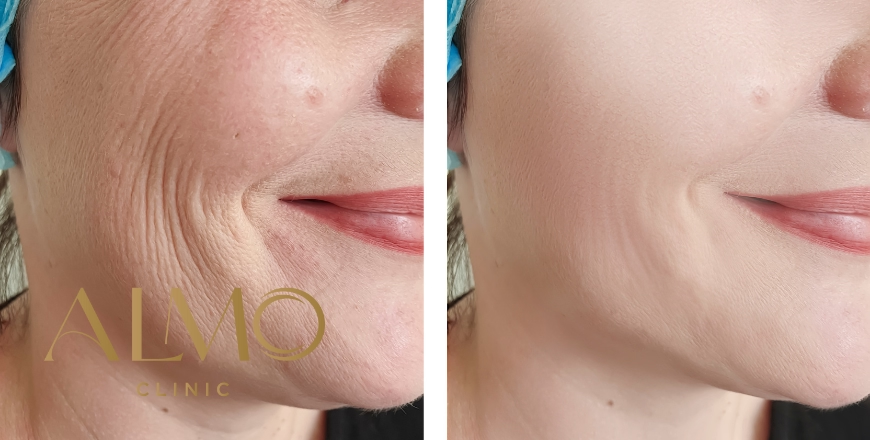
- At 30 years indicate premature aging
At 30, you should only have dynamic lines. If you already have static lines, your skin is aging prematurely.
Why some 30-year-old women already have permanent lines
In my fifteen years evaluating patients, I’ve identified clear patterns about who develops early static lines and who maintains only normal dynamic lines.
Cumulative sun exposure is the most determining factor.
Women who used sun protection inconsistently during their 20s show signs of aging three to five times more accelerated. In Bogotá, this intensifies due to our altitude of 2,640 meters, which significantly increases UV exposure.
Repetitive gesticulation also makes enormous differences.
Those who work many hours in front of screens develop concentration lines earlier.
Those with uncorrected vision problems who frequently squint show premature crow’s feet.
The specific environmental factors of our city also influence
Pollution generates oxidative stress that accelerates aging, while our dry climate can chronically dehydrate the skin if not properly managed.
Finally, modern lifestyle amplifies everything.
Poor sleep reduces nocturnal cellular regeneration. Chronic stress elevates cortisol, which directly affects collagen production. Processed food diet generates systemic inflammation that reflects on the skin.
Addressing forehead wrinkles at 30 and lines at a young age
While many expect aging to start in their late 30s, it is increasingly common to notice forehead wrinkles at 30 or even younger. Undergoing skin changes such as finding smile lines at 19 is usually not a sign of true aging, but rather of highly expressive facial dynamics (laugh lines at 30) and superficial dehydration.
However, when deep forehead wrinkles at 30 or fine lines start appearing as static marks, it points to early collagen breakdown. Developing wrinkles at a young age is often accelerated by modern environmental stressors like blue light from screens, lack of sleep, and Bogotá’s high-altitude UV rays. For those noticing forehead wrinkles at 30, dermatologist-backed prevention focuses on local relaxation of the muscle and restoring the skin barrier before these folds become deep, structural creases.
When prevention is no longer enough
This differentiation is crucial because it completely determines your action plan.
If you only have normal dynamic lines, you’re still in real prevention territory. Your skin responds extraordinarily well to quality topical care. Daily sun protection with SPF 50, properly reapplied, remains your best investment. In 2026, dermatologists recommend combining daily SPF 50 with advanced peptides and niacinamide to support the skin barrier, alongside night-time retinoids, to counteract both UV and digital screen blue light exposure. Serialized antioxidants in the morning neutralize daily environmental damage. Deep nighttime hydration and gentle retinoids two or three times a week maintain optimized cellular renewal.

But if you’ve already developed static lines, topical prevention is no longer enough. You need specific early intervention. This doesn’t mean aggressive treatments, but minimal and precise interventions that stop progression before it becomes a major problem.
Botulinum toxin in preventive doses can relax specific hyperactive muscles. Collagen biostimulators can reactivate natural production. Regenerative treatments can repair accumulated damage. You can read more about non-surgical treatments for early wrinkles like Liftera 2 to see how they stimulate collagen production.
The key is in early and precise intervention, not in waiting for the problem to worsen.
Cases that illustrate when to act
Last week I saw Ana, 31, who arrived convinced she needed Botox immediately.
She had seen social media videos about “early prevention” and was anxious to start treatments. During evaluation with natural light, her skin was practically perfect at rest. She only showed very mild lines when smiling broadly or gesticulating exaggeratedly.
I explained that her money was better invested in quality sun protection, an adequate antioxidant routine, and annual follow-up.
Three years later, she maintains excellent skin without need for medical interventions.
Marcela’s case was different. At 29, working as a programmer, she had developed permanent concentration lines in the glabella from long hours in front of screens.
These lines persisted even when sleeping and had noticeably deepened in six months.
We applied 15 units of botulinum toxin specifically to the responsible muscles, combined with correction of her work ergonomics and regular breaks to relax facial muscles. The lines were completely eliminated and we’ve prevented their reappearance with maintenance every eight months.
Carmen presented an intermediate situation.
At 32 she had completely normal dynamic lines on most of her face, but one horizontal line on her forehead that had begun to remain visible. We treated only that specific area while maintaining the rest with preventive care.
The result is completely natural, without affecting her normal expressiveness.
My specific evaluation protocol
When a 30-year-old woman consults about incipient lines, I use a specific protocol I’ve developed over years of experience.
First I analyze her skin in total rest, with direct natural light and without makeup. I document photographically to have objective reference.
Then I evaluate her habitual and extreme gesticulation, observing how skin responds after each expression and what movement patterns predominate.
I investigate her causal factors: sun exposure history, work and postural habits, current care routine, family history.
This information determines if the aging I observe is normal for her age or accelerated by modifiable factors.
Finally, I determine real intervention need:
My evaluation statistics
- 40% don’t need treatment: Only preventive optimization and annual follow-up
- 35% require frequent follow-up: 6-month control without immediate intervention
- 25% need early intervention: Specific treatment to prevent progression
This distribution reflects my conservative approach: most 30-year-old women don’t need immediate treatments, contrary to what the cosmetic industry suggests.
The advantage of acting intelligently at 30
In my experience, patients who address these changes at 30 obtain significant advantages over those who wait.
- They need considerably less product to obtain optimal results, generally between 30% and 50% less amount.
- Results are more natural because we work with incipient changes instead of established damage.
- Maintenance frequency is lower, typically every six to eight months instead of every three or four.
More importantly, they develop a more intelligent relationship with aging. They understand what changes are normal and which require attention. They establish preventive routines they maintain for decades. They make decisions based on real medical evaluation, not anxiety or social pressure.
Patients who wait until 40 face more complex strategies, greater initial investment, and results that require more time to manifest. Not because it’s “too late,” but because accumulated damage requires more intensive correction.
The smartest plan for your 30s
Your strategy depends completely on your current situation.
If you don’t have static lines yet
Your approach should be intelligent preventive.
Establish a non-negotiable daily sun protection routine, incorporate quality antioxidants in your morning routine, and ensure deep nighttime hydration. Gentle retinoids two or three times a week maintain optimized cellular renewal.
An annual dermatological evaluation will allow you to adjust the strategy according to specific changes.
If you’ve already developed one or two static lines
You need immediate evaluation to determine minimum effective intervention. This generally includes specific treatment of affected areas combined with optimization of causal factors and prevention of new areas.
When to seek professional evaluation?
Schedule immediate consultation if you have:
- Lines that remain in total rest
- Sudden change in skin texture
- Asymmetric lines (only appear on one side)
- Multiple lines appearing simultaneously
Routine evaluation is sufficient if:
- Only normal dynamic lines
- Want personalized preventive plan
- Family history of premature aging
In any case, the objective is to maintain a natural and healthy appearance while preventing major future problems.
Why professional evaluation makes the difference
At ALMO Clinic, our approach is fundamentally conservative. We don’t sell unnecessary treatments. My European training taught me international prevention standards that prioritize long-term skin health over immediate results.
We work with ten-year plans, not single treatments.
We use documentation technology that allows objective evolution comparisons. Each patient receives a personalized plan based on their specific situation, not generic protocols.
Your skin at 30 is a smart investment, not an emotional expense. With correct information and the adequate plan, you can maintain a natural and healthy appearance for the next two decades.
Ready to know exactly what your skin needs? A specialized evaluation will give you complete clarity about your specific situation and the smartest plan for the coming years.
Schedule personalized evaluation → </a> or contact us directly on WhatsApp +57 310 565 3836 .
If you are considering traveling to Bogotá for a preventive treatment, our guide for international patients covers Liftera 2, Morpheus8, and CO2 laser with complete information on timelines and costs, and our medical tourism page walks through trip planning and virtual consultation options.
Scientific References
- “Preventive Dermatology in Young Adults: Focus on Early Wrinkles,” Journal of Investigative Dermatology (2025).
- Wrinkles: Overview
- Skin Aging
- Anti-Aging Skin Care