In summary
Rejuran is polynucleotide derived from salmon DNA: it repairs skin at cellular level, improves hydration and calms inflammation, but generates no volume or structural firmness. Juvelook is PDLLA with hyaluronic acid: alongside hydration it induces new collagen, so it adds firmness. The choice depends on the goal: dull, sensitive or rosacea-prone skin responds better to Rejuran; loss of firmness and static wrinkles to Juvelook. At ALMO Clinic in Bogotá Juvelook starts from $700 USD.
Reviewed by Dr. Oscar Barón · Plastic surgeon · SCCP
$700 USD
- Rejuran Repairs and calms
- Juvelook Repairs and firms
South Korea has been exporting innovation in aesthetic medicine for years. Two of its most influential products in the Latin American market are Juvelook and Rejuran — both injectable, both focused on improving skin quality, both with solid clinical backing. But they are not interchangeable.
They are good for different things.
Understanding that difference isn’t just a technical exercise: it’s the information you need to avoid paying for a treatment that isn’t what your skin actually needs right now.
What is Rejuran and how does it work?
Rejuran (also known as Rejuran Healer or PDRN) is a skin booster based on polynucleotides (PDRN) derived from salmon DNA. Its mechanism of action is different from any traditional biostimulator.
PDRN doesn’t stimulate collagen directly — what it does is repair the dermis’s cellular microenvironment. It activates A2A adenosine receptors, which promotes fibroblast proliferation, improves microcirculation, and has an anti-inflammatory and healing effect. The skin improves its ability to regenerate itself from within.
What does Rejuran work best for?
- Sun-damaged skin with loss of surface quality
- Active or recent acne scars still in the healing process
- Enlarged pores and irregular texture
- Young skin with premature deterioration (smokers, stress, severe sun exposure)
- Uneven tone without significant structural loss
Rejuran doesn’t add volume, doesn’t stimulate collagen the way PDLLA does, and has no immediately visible hydration result. It’s a cellular repairer, not a structural regenerator.
At ALMO Clinic we offer PDRN + Exosomes treatment built on this same cellular-repair mechanism, reinforced with exosomes to enhance cell-to-cell communication. It’s the option indicated when the goal is tissue repair — sun damage, acne scars, under-eye circles — rather than hydration or firmness alone.
What is Juvelook and how is it different?
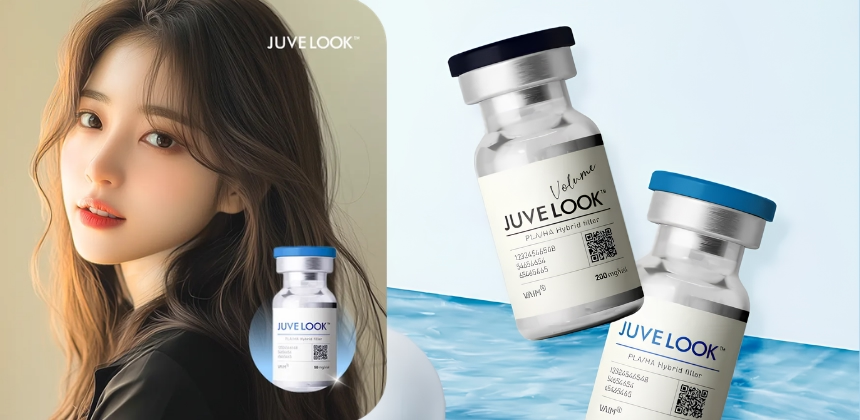
Juvelook combines PDLLA (poly-D,L-lactic acid) with non-cross-linked hyaluronic acid. Unlike Rejuran, Juvelook works through a classic biostimulation mechanism: PDLLA microparticles trigger a controlled inflammatory response that activates fibroblasts to produce type I and type III collagen.
The result is more structural than Rejuran’s: Juvelook improves firmness, reduces fine lines, and can be applied in areas where Rejuran isn’t specifically indicated — such as the periocular area (crow’s feet, eyelids, under-eye circles).
Juvelook’s hyaluronic acid also gives a visible hydration result from day one, something Rejuran doesn’t offer.
For a complete explanation of how Juvelook works, read our guide on what Juvelook is and its hybrid formula.
Direct comparison: Rejuran vs Juvelook across 6 criteria
| Criterion | Rejuran | Juvelook |
|---|---|---|
| Main active | Salmon polynucleotides (PDRN) | PDLLA + hyaluronic acid |
| Mechanism | Repairs cellular microenvironment, improves healing | Stimulates own collagen production + hydration |
| Immediate result | Not visible | Yes — hydration from day 1 |
| Duration | 6–12 months | 18–24 months |
| Number of sessions | 3–4 sessions | 2–3 sessions |
| Periocular area | Possible use but not main indication | ✓ Yes — exclusive differentiator |
| Acne scars | Very effective | Moderate result |
| Fine lines and firmness | Moderate improvement | Significant improvement |
Speed of results
Juvelook gives a visible improvement from the first day thanks to the hyaluronic acid. Rejuran doesn’t have that immediate effect — changes are progressive and become visible starting around weeks 3 to 4.
Duration of effect
Juvelook lasts between 18 and 24 months. Rejuran lasts between 6 and 12 months, so it requires more frequent maintenance. For those looking for the less frequent treatment cycle, Juvelook has the advantage.
Scars, pores and surface damage
Here Rejuran has a real advantage. Its cellular-repair mechanism acts on the dermal microenvironment in a way that favors healing and improves surface texture. For active acne scars, very enlarged pores, or skin with severe photochemical damage, Rejuran is frequently the first choice.
Fine lines, sagging and firmness
For fine lines, loss of firmness and superficial sagging, Juvelook has the advantage. PDLLA stimulates a more intense and structurally more relevant collagen production than Rejuran’s polynucleotides. If the goal is improving facial firmness and reducing fine lines with a lasting result, Juvelook is the better fit.
Who is Rejuran for, and who is Juvelook for?
Rejuran is the best option if:
- Your skin is young (between 25 and 40) with visible surface damage
- You have active or recent acne scars
- Your main concern is texture, pores or uneven tone
- You don’t have noticeable firmness loss or fine lines
- You’re looking for a repair-focused treatment rather than structural regeneration
Juvelook is the best option if:
- Your skin has fine lines, superficial sagging or firmness loss
- You want to treat the periocular area (crow’s feet, eyelids, under-eye circles)
- You’re looking for a longer-lasting result with fewer maintenance sessions
- You want to see a visible improvement from the first session
- You’re between 35 and 60 with visible aging in skin quality
Can they be combined? The double Korean protocol
Yes — and many clinics in Korea use them sequentially within the same protocol. The logic is complementary:
- Rejuran first: repairs the cellular microenvironment, improves local circulation, and prepares the tissue
- Juvelook after: on repaired tissue, PDLLA’s collagen stimulation is more effective
This combined protocol is especially indicated for patients with mature skin that has both surface damage (pores, texture) and firmness loss at the same time. It isn’t the first option for every case, but when properly indicated it can deliver a more complete result than either treatment alone.
For a broader comparison of Juvelook against other biostimulators available in the Colombian market, read our article on Juvelook vs Sculptra.