What changed BBL safety was the injection plane. When fat was placed inside the gluteal muscle it could enter a vein and cause a fat embolism, with mortality close to 1 in 3,000 procedures. With strictly subcutaneous placement, blunt-tip cannulas and ultrasound guidance, that risk drops sharply. There are three questions to ask a surgeon: which plane they inject into, which cannula they use, and whether they are SCCP board-certified.
Reviewed by Dr. Andrés Parra · Cirujano plástico · especialista en láser
Subcutaneous only
- Cannula Blunt tip
- Certification SCCP
The procedure with the highest cosmetic surgery mortality — until 2018
Before 2018, the Brazilian Butt Lift held a distinction that alarmed the plastic surgery community: the highest mortality rate among elective cosmetic procedures at approximately 1 in 3,000 operations. For context, traditional liposuction carries a mortality rate closer to 1 in 50,000. The BBL was an outlier by a significant margin.
This wasn’t a secret. The ASPS and ISAPS published joint advisories in 2018 acknowledging the numbers and issuing emergency guidance to the surgical community. Multiple task forces analyzed the deaths and reached a consistent finding: the mechanism was almost universally the same. Fat injected inside the gluteal muscle — the intramuscular technique that many surgeons were using to maximize volume — was reaching large intramuscular veins and traveling to the heart and lungs, causing fatal fat embolism.
The cause was not the BBL concept. It was a specific technical decision about where to inject the fat.
The 2018 protocol change: one intervention, dramatic results
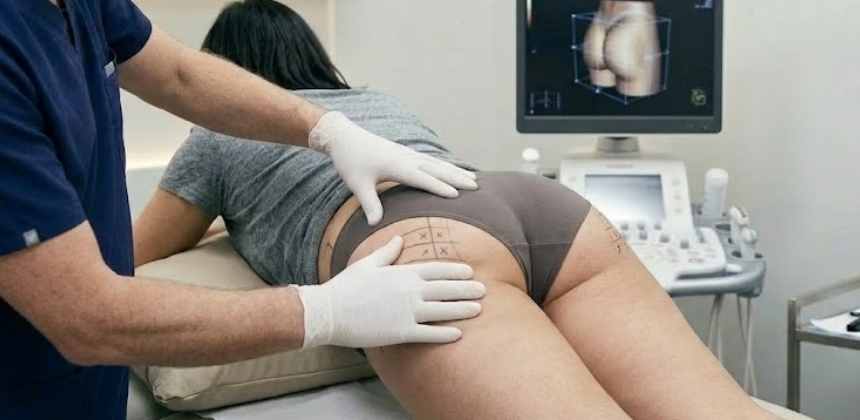
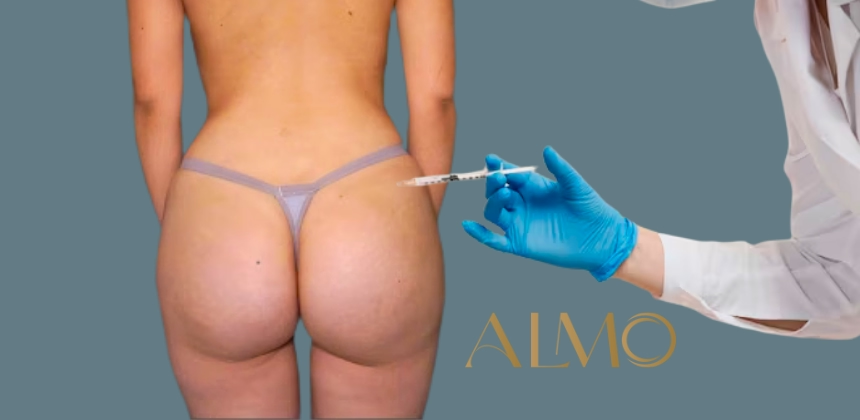
The ASPS task force recommendation was direct: fat must be injected exclusively in the subcutaneous plane — the adipose tissue layer above the muscle — and never through the gluteal muscle itself. The reasoning was anatomical. The subcutaneous layer contains small-caliber venules without direct connections to central venous circulation. Intramuscular veins, by contrast, are large-caliber and drain directly into the inferior vena cava and then to the heart and lungs.
Eliminating intramuscular injection eliminated the embolism pathway. The protocol change required no new equipment, no new training curriculum, and no new surgical skills. It required that surgeons use a different injection plane consistently.
The technical specification: Fat is injected above the fascial plane of the gluteus maximus, never through it. Cannulas with depth markers confirm tip position. The surgeon maintains constant tactile control of injection depth. If the cannula tip cannot be confirmed in the subcutaneous plane, it should not be advanced.
This sounds simple because it is. The challenge was not the technique — it was cultural inertia and the misguided belief among some practitioners that intramuscular injection produced better volume projection. Post-2018 data refutes that belief and documents the lethal cost of maintaining it.
Current mortality data
The results of protocol adoption are documented. In the years following the 2018 guidelines, studies tracking BBL outcomes at compliant practices have demonstrated a mortality rate of approximately 1 in 14,952 procedures — a five-fold reduction from the pre-protocol figure. According to the 2025/2026 ISAPS Global Survey, BBL mortality has stabilized at approximately 1 in 15,000 when performing subcutaneous-only transfer, confirming that it remains within standard safety thresholds of major aesthetic operations.
| Period | Injection technique | Estimated BBL mortality |
|---|---|---|
| Pre-2018 | Intramuscular (common) | ~1 in 3,000 |
| Post-2018 | Subcutaneous-only protocol | ~1 in 14,952 |
| Comparison | Traditional liposuction | ~1 in 50,000 |
| Comparison | Abdominoplasty | ~1 in 13,000 |
The post-protocol BBL mortality rate is now comparable to abdominoplasty — a procedure nobody considers unusually dangerous. This does not mean BBL is risk-free. It means the risk is now in a range that is generally considered acceptable for a major elective procedure, provided the correct technique is used.
The key phrase is “provided the correct technique is used.” Not every surgeon worldwide adopted the subcutaneous protocol after 2018. Patients selecting surgeons outside major certified practices are still exposed to outdated technique. Verification remains the patient’s responsibility.
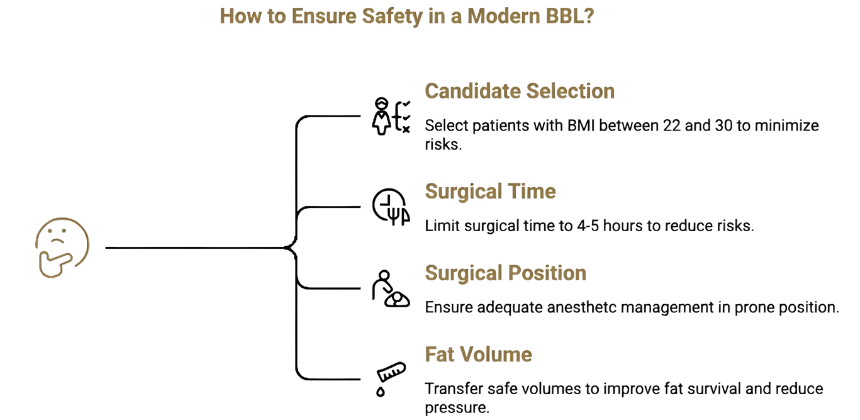
The questions that reveal whether a surgeon is practicing safely
Evaluating a BBL surgeon before booking is not a matter of reading testimonials or counting followers on social media. It requires asking specific technical questions and evaluating the specificity of the responses.
Ask directly:
- In which plane do you inject the fat — subcutaneous or intramuscular?
- How do you confirm cannula depth during injection?
- What cannula type do you use for gluteal fat transfer?
- Do you operate in a certified OR with a cardiovascular anesthesiologist?
- What is your approach when a patient doesn’t have sufficient donor fat?
- What is your complication rate and how do you track it?
A surgeon practicing safe BBL answers these questions without hesitation, with technical specificity, and without defensiveness. The subcutaneous-only protocol is not a trade secret — it is published guidance from the ASPS, ISAPS, and SCCP. A surgeon who cannot or will not explain it precisely is either unaware of it or ignoring it.
Warning signs in responses:
- “I’ve been doing BBL for years without problems” — not an answer about technique
- “My injection gives more volume because I go deeper” — describes intramuscular technique
- Dismissing the 1-in-3,000 historical risk as exaggerated or outdated misinformation
- Inability to specify the injection plane or cannula depth control mechanism
- Guaranteeing fat survival percentages above 70–75%
No legitimate technical concern should be met with defensiveness or redirection. If the conversation makes you uncomfortable, find a different surgeon.
Choosing a plastic surgeon in Bogotá for safe BBL
If you are considering plastic surgery bogota colombia, verify that your specialist is certified by the Sociedad Colombiana de Cirugía Plástica (SCCP). A board-certified surgeon will prioritize your safety over aesthetic volume. For more details on avoiding uncertified centers, read our guide on how to choose a safe clinic in Bogotá.
Understanding plastic surgery packages in colombia
Many international patients seek plastic surgery packages in colombia to coordinate their treatment, recovery housing, and local transportation. A typical, legitimate package covers the surgical fees, anesthesiologist fees, surgical facility costs, post-operative garments, lymphatic drainage massages, and initial post-op medications. However, be cautious of packages offered at unusually low prices or those marketed with aggressive commercial discounts, as safe surgical care requires certified clinical infrastructure and board-certified professionals.
Safety checklist for international patients
| Checklist Item | Description / Verification Method |
|---|---|
| SCCP Certification | Verify the surgeon’s active membership on the official SCCP directory (no exceptions). |
| Clinic Licensing | Ensure the clinic is registered with the regional Secretaría de Salud and has an active IPS license. |
| Injection Plane | Explicitly ask if the surgeon uses a subcutaneous-only fat transfer technique. |
| Surgical Facility | Ensure the procedure is performed in a Level 3 hospital or accredited surgical clinic, not a private office or cosmetic spa. |
| Anesthesia Care | Confirm that a board-certified anesthesiologist will be present throughout the entire surgery. |
Colombia-specific safety considerations
As of 2026, Colombia ranks among the top global destinations for medical tourism and body contouring, offering advanced clinical standards at competitive investment rates.
Colombia’s position as a leading destination for body contouring creates an environment where the surgical quality range is genuinely wide. At accredited practices with SCCP-certified surgeons operating in certified ORs, the clinical standards are equivalent to those at top practices in the US or Western Europe. At the other end of the spectrum, informal providers operating outside certified facilities represent a real and documented risk. In Bogotá, safety is highly correlated with the clinic’s formal credentials. Look for clinics accredited by the Secretaría de Salud and verified facilities that meet international healthcare standards, such as Joint Commission International (JCI) accreditation or certification by the Colombian Ministry of Health. Certified clinics operate under strict protocols for infection control, equipment sterilization, and emergency response.
The distinction between these two environments is not difficult to identify with basic diligence:
- SCCP certification (Sociedad Colombiana de Cirugía Plástica) confirms specialty training equivalent to US ABPS board certification. Verify it on the SCCP registry, not on the surgeon’s website
- Certified surgical facilities in Colombia are audited by INVIMA (the Colombian equivalent of the FDA for healthcare facilities). A certified OR has formal emergency protocols, qualified anesthesia personnel, and equipment for intraoperative complications
- Pricing significantly below the market range for certified practices is a reliable indicator of non-certified facilities or unqualified personnel
The patients who experience serious complications in Colombia are not evenly distributed across the country’s plastic surgery providers. They are concentrated in informal providers outside the certified care system. The decision to seek an extremely low price — well below the certified practice range — is the single largest predictor of a dangerous outcome.
Verified clinical note: The SCCP issued its own guidance aligning with ASPS/ISAPS subcutaneous-only protocol following the 2018 advisories. SCCP-certified surgeons in Colombia operate under the same technical safety framework as ABPS board-certified surgeons in the United States.
Fat survival after BBL is a separate variable from safety, and one that gets confused with it. Between 60% and 70% of transferred fat integrates permanently — the rest is reabsorbed in the first 3 months. This biological variability is not a complication. It is the expected outcome range. A surgeon who cannot explain this honestly, or who promises unusually high survival rates, is making claims that contradict the published literature.
The BBL in Colombia, performed by an SCCP-certified surgeon using the subcutaneous-only protocol in a certified OR, is a procedure with a manageable and documented risk profile. The job of every patient researching this procedure is to verify that the specific surgeon and facility they are considering actually meet these criteria — not assume it based on price, photos, or endorsements.
Contact our SCCP certified surgeons </a>
Schedule your consultation at ALMO Clinic </a> or contact us directly on WhatsApp +57 310 565 3836 .
Medical information presented for educational purposes. Individual risk assessment requires in-person evaluation with a certified plastic surgeon.