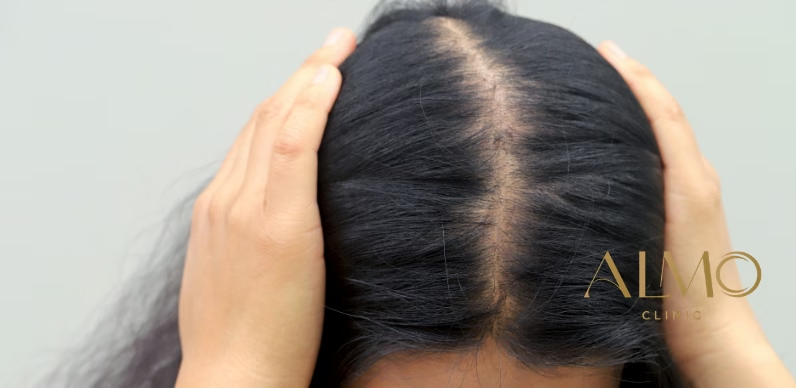
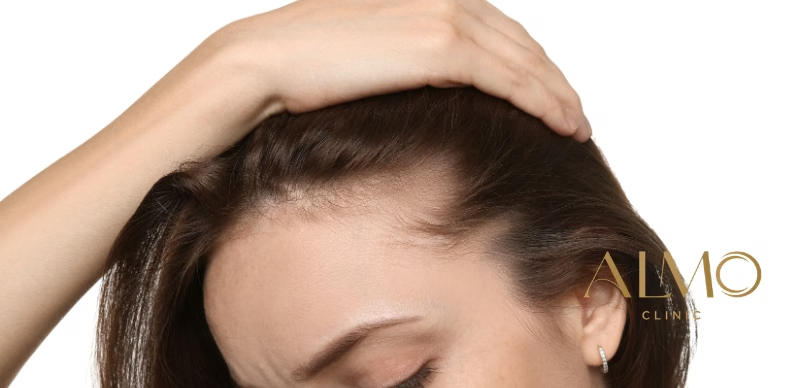
Female hair loss presents differently from male pattern baldness: instead of receding temples and crown thinning, it widens the central parting while preserving the frontal hairline. The most frequent causes are female-pattern androgenetic alopecia, telogen effluvium after childbirth or stress, iron deficiency and thyroid disorders. That is why assessment includes blood work alongside trichoscopy. At ALMO Clinic in Bogotá hair PRP starts from $112 USD per session.
Reviewed by Dr. Oscar Barón · Cirujano plástico · SCCP
Widened central parting
- Hair PRP $112 USD
- Workup Trichoscopy and blood work
Hair loss in women has historically been a topic rarely discussed, despite affecting one in four women at some point in their lives. There is a widespread misconception that alopecia is exclusively a male problem, which has led many women to delay seeking medical help until their hair density loss is already advanced.
The reality is that female alopecia has different causes, patterns and treatments compared to male baldness. Ignoring these differences leads to incorrect diagnoses and ineffective treatments. This article addresses the specific causes of hair loss in women and the medical treatments that actually work according to current evidence.
Why female alopecia is different from male baldness
The first major difference lies in the pattern of loss. While men lose hair following a predictable pattern (recession at the temples, frontal hairline recession, crown baldness), women typically experience diffuse thinning distributed across the top of the scalp, almost always preserving the frontal hairline.
Hormonal differences
In men, the main triggering factor is the follicle’s sensitivity to DHT. In women, the hormonal component is more complex: oestrogens, progesterone, testosterone, thyroid hormones and prolactin are all involved. Any imbalance in this system can trigger hair loss.
More potential causes
Female alopecia has a wider range of potential causes than male alopecia. Factors such as pregnancy, breastfeeding, menopause, polycystic ovary syndrome (PCOS) and thyroid diseases are female-specific triggers that have no male equivalent. This makes diagnosis more complex and requires a comprehensive approach with full hormonal and metabolic analysis.
Different response to treatments
Treatments that work in men are not always appropriate or effective in women. Finasteride, for example, is contraindicated in women of childbearing age. Topical minoxidil works in both sexes, but concentrations and responses may differ. FUE hair transplant in women requires careful assessment of the donor area, which may itself be affected by the same diffuse thinning process.
Most frequent causes
Hair loss in women rarely has a single cause. Most often, multiple factors are contributing simultaneously, which means the approach must be comprehensive.
Hormonal causes
Hormonal changes are one of the most frequent causes of female alopecia. The main scenarios include:
Polycystic ovary syndrome (PCOS). PCOS involves a relative excess of androgens that can trigger female androgenetic alopecia. It is typically accompanied by other symptoms such as irregular periods, acne, hirsutism (excessive facial and body hair) and difficulty losing weight. Treating the associated alopecia requires first stabilising the hormonal profile with endocrinological management.
Menopause. The drop in oestrogens during menopause removes the protective effect these hormones had on the hair follicle. As a result, many women notice progressive hair thinning from around the age of 45 to 50. Hormone replacement therapy may help in some cases, but must be evaluated on an individual basis.
Hormonal contraceptives. Some women experience hair loss when starting or stopping hormonal contraceptives. Individual susceptibility determines the response and, in most cases, the hair recovers once the body adapts to the hormonal change.
Thyroid causes
Hypothyroidism and hyperthyroidism can both cause diffuse hair loss. The thyroid gland regulates cellular metabolism, and hair follicle cells are particularly sensitive to fluctuations in thyroid hormones.
In hypothyroidism, hair becomes dry, brittle and falls out diffusely. In hyperthyroidism, shedding tends to be more sudden and noticeable. In both cases, normalising thyroid function with medication usually restores the normal hair cycle within 3 to 6 months.
Every evaluation of female hair loss should include a complete thyroid profile (TSH, T3, T4) to rule out this cause.
Postpartum cause (postpartum hair loss)
Postpartum hair loss is one of the most frequent consultations in female trichology. It is a type of acute telogen effluvium triggered by the abrupt hormonal change that occurs after childbirth.
Nutritional deficiencies
Women have a higher risk of iron deficiency due to monthly menstrual losses. Low ferritin is one of the most common causes of hair loss in young women and is frequently overlooked.
Zinc, vitamin D and vitamin B12 are other nutrients whose deficiency is associated with hair loss. Restrictive diets for weight loss, unplanned vegan diets and eating disorders are important risk factors.
Chronic stress
Prolonged stress elevates cortisol and disrupts the hair cycle, contributing to chronic telogen effluvium. Women juggling multiple roles — professional, domestic, caregiving — are at particular risk of the chronic stress that affects hair health.
Postpartum hair loss: why it happens and when to be concerned
Postpartum hair loss is so common that many women consider it “normal” and do not seek a consultation. However, understanding the mechanism and knowing when it is not evolving as expected is important to prevent a temporary shedding from becoming chronic.
Why does it happen?
During pregnancy, elevated oestrogen levels keep an abnormally high proportion of follicles in the growth phase (anagen). The result is that many pregnant women have thicker, shinier hair than usual.
After childbirth, the abrupt drop in oestrogens synchronises the mass entry of those follicles into the shedding phase (telogen). The result is that between the second and fourth month postpartum, the woman experiences shedding that can be alarming: hair on the brush, in the shower and on the pillow.
How long does it last?
Typical postpartum hair loss lasts 3 to 6 months. Hair begins to recover spontaneously as the hair cycle renormalises. Most women recover their usual hair density by around the sixth postpartum month.
Warning signs
There are signs that indicate postpartum hair loss is not evolving as it should and requires specialist assessment:
- Shedding does not ease after 6 months
- There are localised areas of loss (rather than diffuse shedding)
- Density does not recover after one year
- Associated with extreme fatigue, loss of eyebrow hair, or nail changes
These signs may indicate an additional factor — such as postpartum iron deficiency or thyroid dysfunction — that is perpetuating the shedding beyond the expected telogen effluvium.
Can it be treated?
In most cases, postpartum hair loss does not require treatment beyond nutritional correction (iron, prenatal vitamins) and patience. However, when shedding is very intense or prolonged, hair PRP and mesotherapy can significantly accelerate recovery.
Available medical treatment options
Treatment of female alopecia must be personalised according to the identified cause. These are the options with the strongest evidence in current medical literature.
Hair PRP (platelet-rich plasma)
Hair PRP involves drawing blood from the patient, processing it to concentrate platelets and growth factors, and reinjecting them into the scalp. These growth factors stimulate the hair follicle and extend its growth phase.
The strongest evidence for PRP is in female androgenetic alopecia and telogen effluvium. Typical protocols include 3 to 4 initial sessions at monthly intervals, followed by maintenance every 3 to 6 months.
Results begin to be noticeable after the second session, with maximum effect reached at around six months. PRP is especially useful for women who cannot tolerate or are not candidates for hormonal treatments.
Hair mesotherapy
Hair mesotherapy consists of intradermal microinjections of nutrients, vitamins, amino acids and active ingredients into the scalp. Each session lasts approximately 20 minutes and requires no downtime.
Mesotherapy is indicated as an adjunct in female androgenetic alopecia, telogen effluvium and as preparation for hair transplant. It is a safe and well-tolerated treatment, with visible results after 4 to 6 sessions.
Hair biostimulators
Biostimulators such as PDLLA (polydioxanone) and hyaluronic acid have gained ground in hair treatment. They stimulate collagen production and growth factors in the scalp, improving the follicular environment and the quality of existing hair.
This approach is particularly useful in women with diffuse thinning and low-quality hair, where the goal is to improve the diameter and resilience of the hair rather than increase the number of active follicles.
FUE hair transplant in women
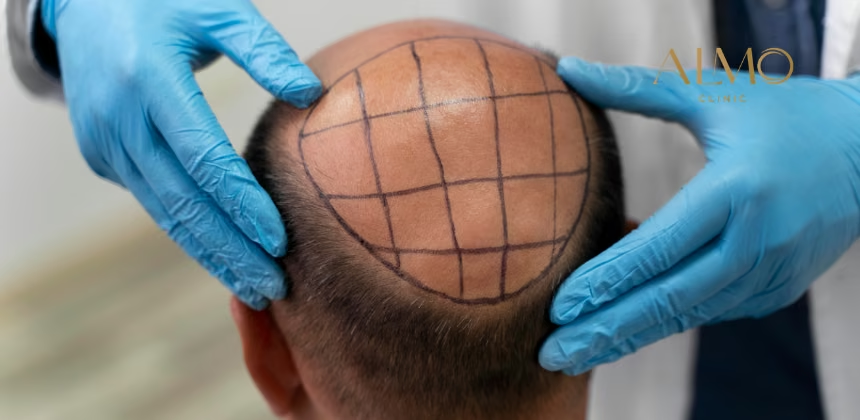
FUE (Follicular Unit Extraction) hair transplant in women requires special considerations. The donor area (occipital) may be thinned, and diffuse loss can affect available density for transplantation.
Pre-operative assessment with digital trichoscopy is mandatory to determine whether the donor area has sufficient density and stability. In appropriately selected women, hair transplant results are excellent, restoring density in frontal zones and the crown.
Topical minoxidil
Minoxidil remains the first-line treatment for female androgenetic alopecia. The 2% concentration is the approved formulation for women, although 5% is used under medical supervision.
The main limitation is the commitment to continuous use. The response tends to be better when started early, and treatment must be maintained indefinitely to preserve results.
If you are looking for female alopecia treatment at ALMO, our certified trichologists design a personalised plan after a complete diagnosis with digital trichoscopy and blood analysis.
Frequently asked questions
Does female alopecia have a cure?
It depends on the cause. Female androgenetic alopecia has no cure but has effective treatment to stop its progression and recover density. Postpartum hair loss and telogen effluvium usually resolve spontaneously. Scarring alopecias have no cure, but early treatment stops the damage.
Why does my hair fall out after giving birth?
It is postpartum hair loss, a type of telogen effluvium caused by the abrupt drop in oestrogens after childbirth. It is temporary and self-limiting, with a typical duration of 3 to 6 months.
Does hair transplant work in women?
Yes, in appropriately selected women. The key is assessing the density and stability of the donor area. Not all women with alopecia are candidates, but many can benefit significantly.
What blood tests should I have to find out why my hair is falling out?
A basic profile includes: ferritin, vitamin D, zinc, TSH, T3, T4, complete blood count, hormonal profile (oestrogens, progesterone, testosterone) and thyroid autoantibodies. Your trichologist will determine the specific tests required for your case.
Does menopause cause hair loss?
Yes. The decrease in oestrogens during menopause removes the hormonal protection of the hair follicle, which can trigger or worsen female androgenetic alopecia.
Female alopecia requires a different, specialised approach. At ALMO Clinic we have certified trichologists, digital trichoscopy and personalised medical treatments for hair loss in women. Schedule your consultation and recover the density and health of your hair.
Ready to get a clear diagnosis for your specific case? Our trichology team is available directly.
Schedule your trichology consultation </a>