An international patient coming to Colombia for rhinoplasty should plan 10 to 14 days in the country: 2 days beforehand for assessment and labs, surgery with an overnight stay, and 7 to 10 days of local recovery before flying, because the splint comes off around day 7 to 10. The essential check is that the surgeon is certified by the Colombian Society of Plastic Surgery (SCCP). At ALMO Clinic in Bogotá ultrasonic rhinoplasty starts from $4,500 USD.
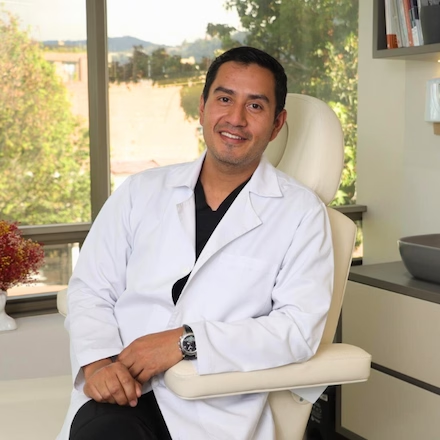
Reviewed by Dr. Oscar Barón · Cirujano plástico · SCCP
10–14 days
- From $4,500 USD
- Verify SCCP certification
In recent years ALMO Clinic has treated patients from Miami, New York, Toronto, Madrid and Mexico City who came to Bogotá specifically for rhinoplasty.
This is not a coincidence. And it is not only about price.
It is the combination of surgeons with high-level training, updated technology, reasonable costs and a city that facilitates post-operative recovery.
This guide is for those in the evaluation phase: is it worth coming to Colombia for rhinoplasty? How do you do it safely?
If you’re still evaluating whether surgical correction is the right choice for your goals, our guide on what rhinoplasty is for covers what the procedure can realistically achieve.
Why Colombia has become a reference for international plastic surgery
Colombia has a tradition of more than four decades in plastic surgery. Scientific societies such as the SCCP (Sociedad Colombiana de Cirugía Plástica — Colombian Society of Plastic Surgery) — affiliated with IPRAS, the international reference body — set training and certification standards for the country’s plastic surgeons.
Bogotá, in particular, concentrates the largest number of experienced specialists, the best-equipped clinics and the most recent technological advances — including the piezoelectric ultrasonic technique for rhinoplasty, which reduces recovery time and allows greater precision in bone sculpting.
The result is a medical ecosystem that can compete in technical quality with international reference centres, with a significant cost differential.
What rhinoplasty in Colombia actually costs
The total cost of rhinoplasty in Colombia for an international patient depends on several factors: the complexity of the procedure, days of hospitalisation and the accommodation plan.
As a general reference, the cost of the surgical procedure itself — including surgeon, anaesthesiologist and hospital facilities — is significantly lower than at equivalent clinics in the United States or Spain.
However, the total trip cost includes:
- Round-trip flights
- Minimum 10–14 days accommodation
- Local transport
- Post-operative follow-up appointments
- Medications and recovery materials
All in, the final cost remains competitive for most international patients. But it is important to budget the complete trip, not just the surgery.
An important warning: a price that is too low is a red flag, not an advantage. Procedures significantly below certain thresholds usually imply compromises in facility standards, anaesthesia quality or surgeon experience.
How to choose the right surgeon from abroad
This is the most important decision in the process. Here are the non-negotiable criteria:
Plastic Surgery Board Certification
In Colombia, a plastic surgeon must be certified by the SCCP (Sociedad Colombiana de Cirugía Plástica) or an equivalent internationally recognised entity. This title is different from “aesthetic surgeon” — which in many countries does not require the same specialised training.
Verify that the doctor is listed in the official SCCP directory and has specific rhinoplasty experience — not just general plastic surgery.
Portfolio of real cases
A surgeon with solid rhinoplasty experience has a documented portfolio. Ask to see cases with morphologies similar to yours: profile, wide nose, tip, dorsum. Results should show consistency and naturalness — not a single “star” result.
Male patients in particular should ask to see cases with similar anatomy — our guide on rhinoplasty for men explains the specific aesthetic parameters that keep a male result natural.
Remote pre-operative consultation
Before travelling, a virtual consultation with the surgeon must be possible. In this session, photos are assessed, objectives defined, expectations discussed and specific risks for your case established. If the surgeon is not available for this before your arrival, that is a warning sign.
Accredited facilities
Surgery must be performed in a clinic or operating room with institutional accreditation, with a specialist anaesthesiologist and standardised safety protocols. Not in non-certified “consulting rooms”.
Trip planning: what you need to know
How long should you stay in Colombia?
A minimum of 10–14 days after surgery before taking a return flight. The first 7 days require the most care: relative rest, close post-operative follow-up, control of bruising and swelling.
At days 10–14, dressings are removed and an evaluation is made of recovery progress. Most surgeons authorise the flight after this evaluation, provided recovery is going well.
What altitude is Bogotá at?
2,600 metres above sea level. This has implications for post-operative recovery: lower barometric pressure can slightly increase swelling and slow some healing processes. It is a minor factor, but worth discussing with the surgeon.
How to get to follow-up appointments from a hotel?
At ALMO Clinic we coordinate transport to post-operative appointments for patients coming from outside. This is part of the logistics we resolve in advance.
Which areas to stay in?
For patients coming to recover, the Chicó, Cabrera and Usaquén areas offer good infrastructure, accommodation options and proximity to north Bogotá clinics. There are also apartments specialised in post-surgical recovery.
Questions to ask before committing
Before confirming the surgery and buying flights, you are entitled to these answers:
- How many rhinoplasties have you performed in the past year?
- What is the protocol for complications? How is a revision handled if the result is not as expected?
- Does the facility where you operate have institutional accreditation?
- Who will be the anaesthesiologist and what is their specialisation?
- Is remote post-operative follow-up possible once I return to my country?
A serious surgeon answers all these questions without discomfort.
How we see it at ALMO
When an international patient comes to ALMO, the process starts weeks or months before they set foot in Bogotá.
The virtual pre-operative consultation is the first step: we assess photos, discuss realistic objectives and determine whether the rhinoplasty the patient wants corresponds to their anatomy. Sometimes there are significant expectation adjustments — and it is better to have those before the trip.
Once in Bogotá, the surgeon has the patient for an in-person evaluation before surgery, and the team accompanies them throughout recovery.
If you are in the evaluation phase and want to know whether ALMO is the right clinic for your case, the first step is the virtual consultation.
Request your virtual consultation with our plastic surgery team →
Ready to start planning your trip to Bogotá for rhinoplasty? Reach out to our team directly.
Ask about rhinoplasty in Colombia </a>
Frequently asked questions
Is rhinoplasty safe in Colombia?
Yes, provided you choose a plastic surgeon certified by the SCCP and a clinic with institutional accreditation. Colombia has a formal medical system with internationally recognised training standards. The surgical risks are the same as in any country; what varies is the standard of the team and facilities — which is exactly what you need to verify before deciding.
Can I have the initial consultation from abroad?
Yes. The virtual pre-operative consultation is standard practice for international patients. It is conducted by video call and allows photo assessment, objective setting and plan establishment before the patient travels.
When can I fly after rhinoplasty?
Generally between days 10 and 14 post-operative, with the surgeon’s authorisation. Long-haul flights are usually recommended from 2 weeks, when initial swelling is under control.
Do rhinoplasty results show from day one?
No. Post-operative swelling can be intense in the first days. The definitive shape of the nose is not visible until 6 to 12 months. First orientative results are visible between months 1 and 3.
What if I need a revision while back in my country?
Before surgery, the remote follow-up protocol and conditions for a potential revision should be clearly established. The surgeon should be available for virtual post-operative consultations. In cases of acute complications, the patient should attend the emergency service in their home country and maintain contact with the team in Bogotá. For very minor concerns that don’t require a second surgery, it’s worth asking your surgeon whether non-surgical rhinoplasty could be a temporary local option while you plan next steps.