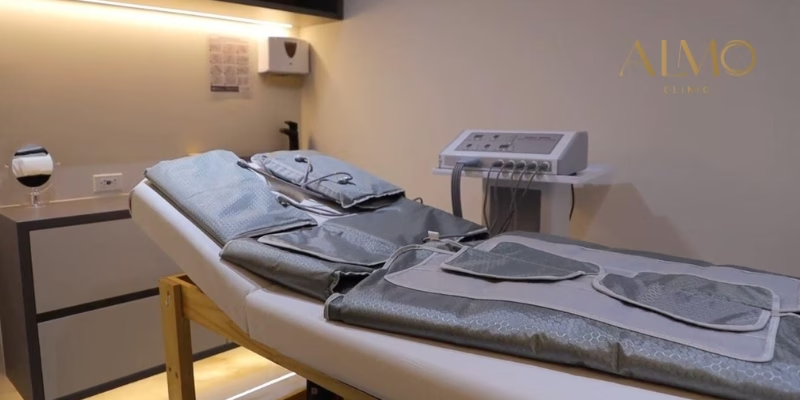
With solid clinical backing, rosacea is treated with topical metronidazole and azelaic acid, topical ivermectin when Demodex is involved, oral doxycycline at anti-inflammatory dose for papulopustular forms, and intense pulsed light (IPL) or vascular laser for persistent redness and visible vessels — the only thing that clears them. Without sufficient evidence sit natural remedies and topical corticosteroids, which actually worsen rosacea over time. At ALMO Clinic in Bogotá IPL starts from $225 USD.
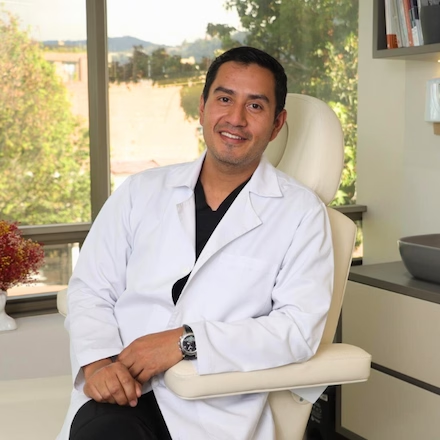
Reviewed by Dr. Oscar Barón · Cirujano plástico · SCCP
$225 USD
- For visible vessels IPL or vascular laser
- Contraindicated Topical corticosteroids
You have had rosacea for a while — or have just been diagnosed — and now you are looking at a range of options: lasers, creams, antibiotics, natural remedies, pharmacy products.
The problem is that these options do not all have the same level of evidence. Some have decades of clinical studies behind them; others are trends or marketing promises.
This guide focuses on what medical dermatology supports.
The foundational principle: treatment depends on the subtype
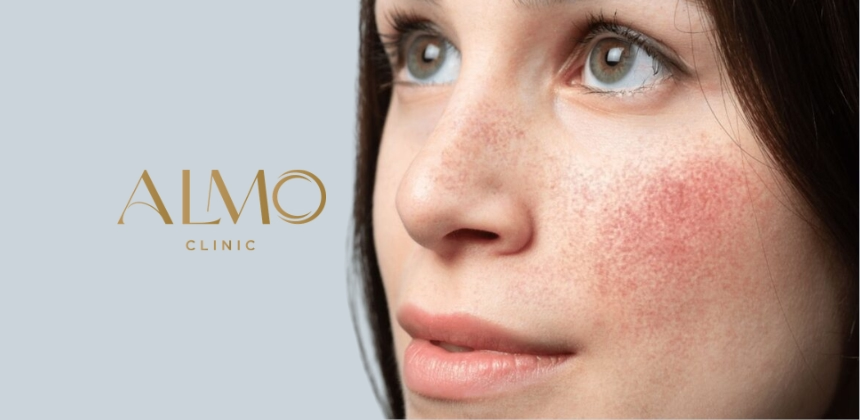
This is non-negotiable. What works for erythematotelangiectatic rosacea (vessels and redness) is different from what works for papulopustular rosacea (acne-like inflammation). And what applies to rhinophyma (phymatous subtype) is different again.
If you have rosacea and have never had a medical evaluation that identifies your subtype, you may be using a treatment that does not correspond to your case — and concluding that “rosacea has no solution” when the real problem is the wrong tool.
Treatments for the vascular component: erythema and telangiectasias
Nd:YAG 1064 nm laser
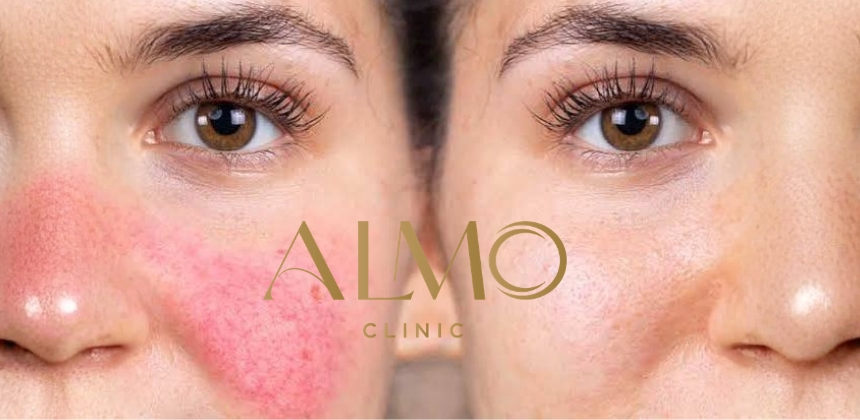
The gold standard for telangiectasias — visible red vessels — and for persistent erythema in the erythematotelangiectatic subtype.
The laser emits a wavelength selectively absorbed by haemoglobin in blood vessels. The vessel coagulates and the body reabsorbs it. Result: visible vessels disappear and baseline erythema reduces.
Typically 2 to 4 sessions are needed for optimal results. Maintenance is usually every six to twelve months.
Intense Pulsed Light (IPL)
IPL is not a laser — it is broad-spectrum light. For erythematotelangiectatic rosacea, it acts on superficial vessels with good results, though with less precision than Nd:YAG for very fine or deep vessels.
Its advantage: it can simultaneously improve diffuse erythema and telangiectasias with less recovery time than some lasers.
Topical brimonidine 0.33%
Brimonidine is an alpha-adrenergic agonist that produces local vasoconstriction: it causes facial vessels to contract. The visible result is a reduction in redness within 30 minutes that lasts 8 to 12 hours.
It is a temporary solution — it does not eliminate telangiectasias or “cure” baseline erythema — but it is very useful for patients who need to manage redness in specific situations (meetings, events).
A rebound effect — more intense redness when the effect wears off — can occur in some patients. It should be used under medical guidance.
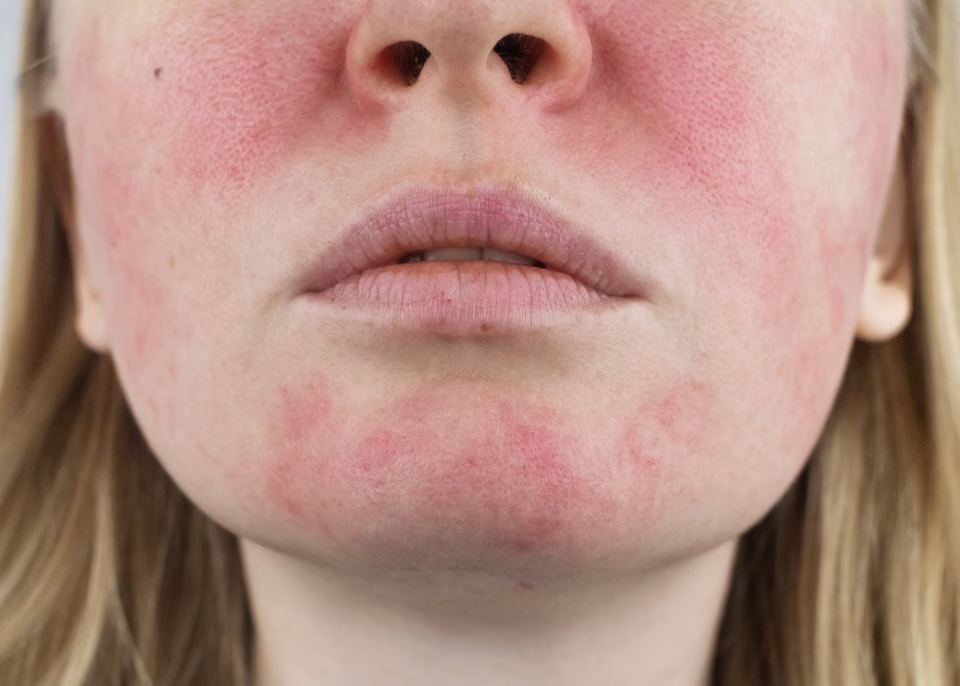
Treatments for the inflammatory component: papulopustular rosacea
Topical metronidazole 0.75–1%
For decades the cornerstone of papulopustular rosacea treatment. Its exact mechanism in rosacea is not fully elucidated — it does not act as an antibiotic per se, but appears to have a direct anti-inflammatory effect.
Available as gel or cream, applied once or twice daily. Visible results in 4 to 8 weeks. Good tolerability in most skin types.
Azelaic acid 15% (gel) or 20% (cream)
Inhibits tyrosinase (also useful for hyperpigmentation) and has anti-inflammatory and antikeratinising effects. In papulopustular rosacea, it reduces papules and erythema comparably to metronidazole.
Its advantage: a very high safety profile. One of the few actives also indicated during pregnancy.
Ivermectin 1% (cream)
Has emerged in recent years as one of the most effective treatments for papulopustular rosacea, especially in cases where Demodex folliculorum plays a relevant role.
Comparative studies show topical ivermectin outperforms metronidazole in reducing inflammatory lesions at 16 weeks. And results are better maintained long-term.
Applied once daily for 16 weeks in the attack phase, followed by less frequent maintenance.
Doxycycline at sub-antimicrobial doses (40 mg)
For moderate-to-severe papulopustular rosacea, modified-release doxycycline at 40 mg/day is the systemic option with the strongest evidence. At this dose it does not act as an antibiotic — it does not generate bacterial resistance — but as an anti-inflammatory.
It is generally combined with topical therapy for 3 to 6 months and then tapered. Indefinite use is not recommended.
Treatments for the phymatous subtype
Rhinophyma and other phymatous subtype manifestations do not respond to topical treatments or standard systemic medication. Once established tissue thickening is present, the approach is surgical:
- Ablative CO₂ laser: Removes hypertrophied tissue in a controlled manner with excellent cosmetic outcomes
- Electrosurgery: Alternative to laser where this technology is unavailable
- Conventional surgery: For very advanced cases
Early detection of the phymatous subtype is important precisely to intervene before thickening becomes severe.
What lacks sufficient evidence
To be clear:
- Tea tree oil, aloe vera, liquorice extract applied to rosacea: No robust clinical evidence for this indication. They do not harm, but they do not resolve the condition either
- “Anti-inflammatory diet” as sole treatment: Can be a complement (certain foods are triggers), but does not substitute medical treatment
- Probiotics for rosacea: Promising research but no definitive conclusions for standard clinical application yet
- Topical copper or zinc remedies: Very limited efficacy in clinical trials
How we see it at ALMO
The most common mistake we see is not using “alternative” treatments — it is using the right treatments for the wrong subtype.
An IPL laser applied to active papulopustular rosacea can aggravate the inflammation. Topical metronidazole in purely erythematotelangiectatic rosacea will have little impact on already-formed vessels.
That is why the protocol always starts with subtype diagnosis. From there, the combination of tools — laser, topicals, systemics, photoprotection — is built on clear logic.
Book your dermatology consultation for rosacea at ALMO Clinic →
Not sure which treatment matches your rosacea subtype? Ask our dermatology team directly.
Ask about rosacea treatment options </a>
Frequently asked questions
How many laser sessions are needed for rosacea?
For the erythematotelangiectatic subtype, the standard protocol is 2 to 4 sessions with Nd:YAG laser or IPL, spaced 4 to 6 weeks apart. The exact number depends on telangiectasia density and erythema intensity. Maintenance sessions are usually done once or twice a year.
Does rosacea come back after laser treatment?
The laser eliminates the treated vessels, but does not change the skin’s tendency to form new ones. With cumulative sun exposure and uncontrolled triggers, new telangiectasias can appear. That is why photoprotection and trigger management are permanent, even after laser treatment.
Are oral antibiotics used indefinitely for rosacea?
No. Sub-antimicrobial doxycycline is used in cycles of 3 to 6 months to control active inflammation. Long-term indefinite use is not indicated. After the attack phase, maintenance is with topical treatments.
Can rosacea be treated with creams alone?
In mild papulopustular or erythematotelangiectatic cases without established telangiectasias, topical treatment may be sufficient. In cases with visible vessels, intense persistent erythema or moderate-to-severe inflammatory lesions, combining topicals with laser or systemic medication is generally needed.
Is ivermectin for rosacea the same as ivermectin for parasites?
No. Topical ivermectin 1% for rosacea is a cutaneous formulation with minimal systemic absorption. It is completely different from oral or injectable presentations for parasitosis. The mechanisms also differ: in rosacea it acts on Demodex and has local anti-inflammatory effects.
Do medical aesthetic treatments have contraindications?
Yes. Every treatment — topical or procedure-based — has relative and absolute contraindications. For laser and IPL in rosacea: active skin infections, recent tanning, certain photosensitising medications, pregnancy (laser) and some autoimmune conditions. The pre-treatment evaluation identifies these factors for each patient.