Operating safely in Colombia comes down to four concrete checks: that the surgeon is listed in ReTHUS, the Ministry of Health registry, as a plastic surgery specialist and certified by the SCCP; that the facility holds a Health Secretary licence; that an anesthesiologist is present in theatre rather than sedation administered by the operating surgeon; and that a post-operative follow-up plan exists before you fly home. A price far below market almost always means one of those is missing.
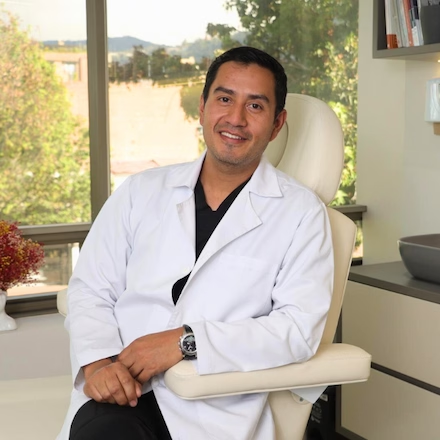
Reviewed by Dr. Oscar Barón · Cirujano plástico · SCCP
ReTHUS and SCCP
- Verify facility Health Secretary licence
- Require Anesthesiologist in theatre
Colombia has been a destination for plastic surgery for patients from around the world for decades. But not all stories end well.
In recent years there have been reports of serious complications — and in some cases deaths — associated with plastic surgeries performed in inadequate conditions: non-certified facilities, surgeons without the required specialisation, absence of safety protocols.
This guide exists so you know exactly how to distinguish a serious centre from one that is not. The information you need to make an informed decision is available. The problem is that many patients do not know where to look for it or what to ask.
The real question: is the risk the country or the provider?
Here is the uncomfortable truth: accidents and serious complications are not exclusive to Colombia. They occur in the United States, Spain, Mexico and any other country.
What determines the safety of a surgery is not geography. It is the combination of:
- The surgeon’s level of training and experience
- The quality of the facilities where they operate
- The standard of anaesthesia used
- Post-operative follow-up protocols
A certified plastic surgeon operating in an accredited clinic in Bogotá offers safety standards comparable to those of any international reference centre.
A non-certified operator working in a non-authorised space in any city in the world — Bogotá, Miami or Madrid — represents a real risk.
How to verify that the surgeon is genuinely certified
In Colombia, the title of “Plastic Surgeon” is regulated: it requires undergraduate medical education, general medical residency and a 3-year specialisation in plastic, reconstructive and aesthetic surgery recognised by the Ministry of Health.
The body that certifies and brings together plastic surgeons is the SCCP (Sociedad Colombiana de Cirugía Plástica, Reconstructiva y Estética). The member directory is available on their website and is independently verifiable.
What NOT to confuse:
- “Aesthetic surgeon” does not equal “plastic surgeon” in Colombia
- “Aesthetic doctor” or “doctor with aesthetic specialisation” are titles that do not qualify for plastic surgery
- Some surgeons use the term “plastic surgery” in their advertising without holding the corresponding certification
Before any commitment, search the surgeon’s name in the SCCP directory. If they are not listed, that is information enough.
How to verify the facilities
Surgeon certification is not sufficient if they operate in inadequate facilities. Clinics and operating rooms where plastic surgeries are performed in Colombia must be licensed by the corresponding Health Secretariat.
Facilities of the highest standard have additional certifications such as:
- ICONTEC (Colombian Institute of Technical Standards and Certification)
- JCI (Joint Commission International) for clinics with international standards
What adequate facilities must have:
- Operating room with complete general anaesthesia systems
- Post-operative recovery unit
- Emergency and transfer protocol
- Specialist physician anaesthesiologist (not a technician)
Ask for the exact address where the surgery will take place and verify its licensing. A serious clinic provides this information readily.
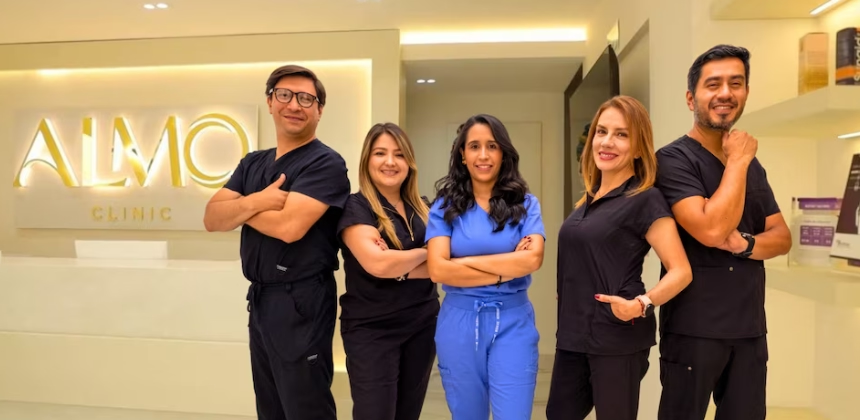
Questions to ask before committing
About the surgeon:
- Are they listed in the SCCP directory? What is their registration number?
- How many procedures of this type do they perform per year?
- Can they show documented cases with morphologies similar to mine?
- Are they available for a pre-operative consultation before the trip?
About the facilities:
- Where exactly will the surgery take place?
- Does the facility have current licensing?
- Who will be the anaesthesiologist and what is their specialisation?
- Is an ICU or emergency service available in case of complications?
About post-operative care:
- How many in-person follow-up days are included?
- Is there a remote consultation protocol once the patient returns home?
- How is a complication managed if it occurs weeks after return?
About pricing:
- What exactly does the quoted price include? (Facilities, anaesthesia, hospitalisation, medications)
- What additional costs might arise?
Red flags you should not ignore
Price significantly below market
Costs have a floor determined by medical team fees, facility use, anaesthesia and materials. A price well below that floor indicates something in that equation is missing.
Inability to verify certification
If the doctor does not appear in the SCCP directory or cannot provide their registration number, do not proceed.
Absence of a real pre-operative consultation
A surgeon who agrees to operate without a detailed patient evaluation — in person or virtually — is not following the minimum standard.
Non-verifiable facilities
If you cannot confirm exactly where the surgery will take place, or if the facilities have no verifiable licensing, that is a warning sign.
Pressure to decide quickly
Elective surgeries are not emergencies. A doctor who pressures you to decide before you have all the information you need is not prioritising your interests.
Do medical spa treatments have contraindications?
Yes — and this is a question every patient should ask before any procedure, surgical or not.
The most relevant contraindications in plastic surgery include:
- Uncontrolled cardiovascular or pulmonary disease
- Coagulation disorders
- Uncontrolled diabetes
- Certain autoimmune conditions
- Active smoking (significantly increases risk of healing complications)
- BMI well above the healthy range (depending on the type of procedure)
The complete pre-operative evaluation — including laboratory work, anaesthetic assessment and risk factor evaluation — is part of any serious protocol and is designed precisely to identify these contraindications before surgery.
Do surgeries leave visible scars?
Every surgery involving incisions leaves a scar. What varies is the visibility of that scar based on:
- The surgical technique used and the location of incisions
- The surgeon’s skill in wound closure
- Each patient’s individual skin characteristics
- Scar care during the post-operative period
An experienced surgeon plans incisions in strategic areas — natural folds, minimal tension lines — to minimise visibility. Post-operative care includes silicone creams, photoprotection of the scar and, in some cases, treatments such as fractional laser to improve mature scar quality.
In procedures such as open-technique rhinoplasty, the columella scar — between the nostrils — is virtually invisible at 6 to 12 months in most cases.
How long do the effects of aesthetic surgery last?
This depends on the procedure and individual factors, but here is an honest overview:
- Rhinoplasty: Results in bone and cartilage structure are permanent. The nose will continue to age naturally but the structural changes remain.
- Abdominoplasty: Maintains results if the patient does not have subsequent pregnancies or significant weight changes.
- Blepharoplasty (eyelid surgery): Results typically last 7 to 10 years before natural ageing again affects the area.
No surgical procedure stops natural ageing. What it does is create a structural improvement that persists over time within the context of normal ageing.
How we see it at ALMO
Every time an international patient comes to our consultation, one of the first things we do is make sure they have all the information they need to make a free and informed decision.
This includes being transparent about the risks of the specific procedure, the contraindications that could affect their case, the actual recovery duration and what can and cannot be expected from the result.
We do not work under pressure. We do not promise what we cannot guarantee. And we make it straightforward for the patient to independently verify information about our team and facilities.
Request information and a virtual consultation with our surgery team →
Want to verify our surgeons’ credentials or ask about our safety protocols before committing? Reach out directly.
Schedule your safety consultation </a>
Frequently asked questions
Do the effects of cosmetic surgeries last forever?
Depends on the procedure. A well-performed rhinoplasty has permanent results in bone and cartilage structure. Aesthetic procedures do not stop natural ageing, but structural results tend to be long-lasting.
How do I know if a plastic surgeon in Colombia is board-certified?
By verifying their registration in the official directory of the Sociedad Colombiana de Cirugía Plástica, Reconstructiva y Estética (SCCP). The directory is public and accessible from their website.
Is the pre-operative evaluation mandatory before plastic surgery?
Yes, it is an unavoidable medical standard. It includes laboratory work, anaesthetic assessment and clinical evaluation. Any surgeon who does not require it is not following the correct protocol.
How long after surgery before returning to normal activities?
Depends on the procedure. As a reference, in rhinoplasty non-intensive work can be resumed in 7–10 days and exercise at 4–6 weeks. In abdominoplasty, return to work is between 2 and 3 weeks and exercise at 2 months. The surgeon gives specific guidance based on each patient’s progress.
What happens if there is a complication after returning home?
First: attend the emergency service in your country of residence for immediate care. Second: contact the medical team in Colombia to coordinate management. A clear protocol for this scenario must be established before surgery — not after.