In summary
Post-surgical fibrosis is the hard, uneven areas that form when scar collagen organises irregularly after liposuction. It is prevented by wearing the compression garment consistently for 4 to 6 weeks and starting lymphatic drainage in week 2. Once established it is treated with therapeutic massage, ultrasound or radiofrequency. It should be distinguished from normal swelling: swelling is diffuse and resolves on its own, while fibrosis is localised, hard and persists beyond the third month.
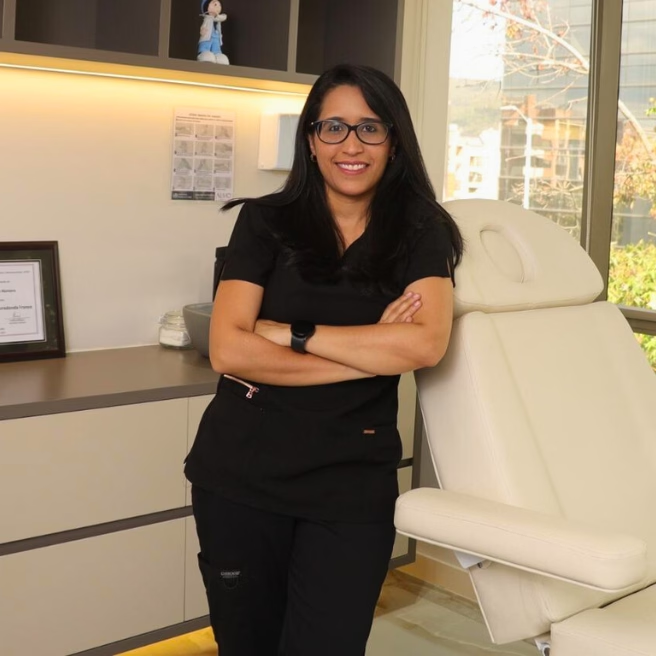
Reviewed by Dr. Martha Peñarredonda · Plastic surgeon · SCCP
Garment 4–6 weeks
- Lymphatic drainage From week 2
- Warning sign Hardness after month 3
Last updated: July 2026 · Reviewed by Dr. Martha Peñarredonda
Few things cause more anxiety after liposuction than touching your abdomen and feeling hard areas where there used to be soft swelling. The word behind almost every search is the same: fibrosis. This guide explains exactly what it is, how to tell normal healing from something that needs attention, and what actually works to prevent and treat it.
What is fibrosis after lipo
When the liposuction cannula removes fat, it leaves internal tunnels that the body must repair. That repair produces scar collagen. If the collagen is laid down in a disorganized or excessive way, hard bands and nodules form: that is fibrosis. It appears most often in the abdomen and flanks — the areas with the largest treated surface — and can also occur after a tummy tuck or lipoabdominoplasty.
Normal firmness vs. problematic fibrosis
| Sign | Normal recovery | Fibrosis that needs attention |
|---|---|---|
| When it appears | Weeks 2-6 | Persists or worsens after month 3 |
| How it feels | Diffuse, “cardboard-like” firmness | Localized nodules, cords or plaques |
| Pain | Mild tenderness that improves | Persistent or increasing pain |
| Skin | Uniform appearance | Retractions, dents or waviness |
| Evolution | Softens month by month | No change or progression |
If your symptoms sit in the right-hand column, do not wait for it to pass: early fibrosis responds far better to treatment than established fibrosis.
How to prevent fibrosis
Wear the compression garment properly
Uniform compression prevents fluid from pooling in the internal tunnels (seromas), one of the precursors of fibrosis. Wear it for the indicated time — typically 4-6 weeks — and correctly fitted: a wrinkled or badly positioned garment creates pressure folds that mark the tissue.
Lymphatic drainage massage from the first week

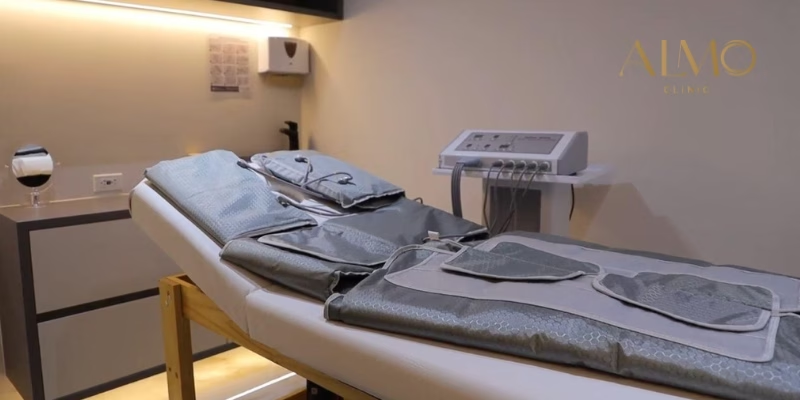
Lymphatic drainage performed by trained staff mobilizes inflammatory fluid and prevents it from organizing into fibrous tissue. It is the prevention measure with the best cost-benefit ratio and is part of the standard post-op protocol for liposculpture at ALMO Clinic.
Attend your follow-up visits
Your surgeon detects early hardening at follow-up visits and adjusts the protocol (drainage frequency, start of device therapy) before fibrosis becomes established. Skipping follow-ups is the most expensive mistake of the post-op period.
Treatments once fibrosis has appeared
For mild to moderate fibrosis, first-line treatment is intensive lymphatic drainage combined with therapeutic ultrasound or radiofrequency, which soften the disorganized collagen and stimulate its remodeling. Microneedling radiofrequency technologies such as Morpheus8 are also used to improve residual surface irregularities.
Severe fibrosis with retractions or contour deformities may require surgical release of adhesions or corrective liposculpture. These are the minority of cases — and they reinforce the central lesson: prevention and early management define the outcome.
Frequently asked questions
How long does fibrosis last after lipo?
Mild physiological fibrosis softens progressively between months 3 and 6. If hard, painful or irregular areas persist at 6 months, it is established fibrosis and should be actively treated.
Does fibrosis massage hurt?
Properly performed lymphatic drainage is gentle and should not be painful. “Strong massages that break up fibrosis” are a risky myth: repeated trauma can inflame the tissue further and make the problem worse.
Is fibrosis the surgeon’s fault?
Not necessarily. Technique matters, but so do your individual healing biology, garment and drainage compliance, and factors like smoking. What does depend on the medical team is close follow-up to detect and treat it early.
Can I exercise if I have fibrosis?
Gradual physical activity, cleared by your surgeon, actually helps: it improves circulation and tissue remodeling. What must be avoided is intense exercise too early, while the tissue is still in its inflammatory phase.
Recovery is planned too
A well-performed liposculpture does not end in the operating room: it ends when the tissue has matured without sequelae. At ALMO Clinic the post-operative protocol — garment, lymphatic drainage and follow-up until the final result — is included in your quote, because the difference between a good and a bad result is decided in these weeks. We welcome international patients in Bogotá.
Book your specialist assessment