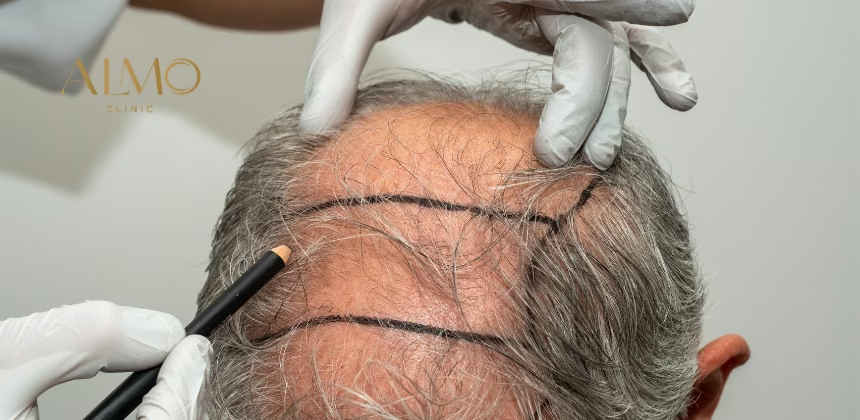
An FUE hair transplant is done in a single day and has four stages: designing the hairline, extracting follicles one by one with a precision micromotor, preparing the grafts, and implanting them following the hair's natural angle. Transplanted hair sheds between weeks 2 and 4 — this is expected — and starts growing permanently around month 3 or 4, with the full result at 12 months. At ALMO Clinic in Bogotá it starts from $1,125 USD.
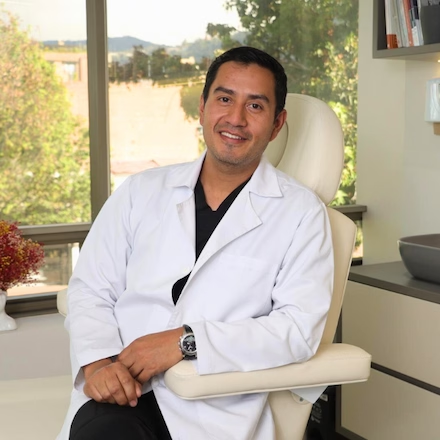
Reviewed by Dr. Oscar Barón · Cirujano plástico · SCCP
$1,125 USD
- Expected shedding Weeks 2–4
- Full result 12 months
Hair transplant surgery has evolved significantly in the past decade, and the Follicular Unit Extraction (FUE) technique is now the standard of care for hair restoration worldwide. Unlike older methods that left linear scars, FUE offers natural results with virtually no visible scarring.
At ALMO Clinic in Bogotá, we specialize in FUE hair transplantation for both local and international patients. This guide will walk you through every step of the process — from understanding the technique to knowing exactly what to expect during recovery and when your final results will appear.
For a personalized assessment, consult our hair transplant specialists in Bogotá.
What is the FUE technique?
FUE, or Follicular Unit Extraction, is a hair transplant method where individual follicular units are harvested from a donor area (typically the back and sides of the scalp) and implanted into the areas experiencing thinning or baldness.
Unlike the older FUT technique, which required removing a strip of scalp and left a linear scar, FUE involves extracting follicles one by one using micro-punches of 0.7 to 0.9 mm in diameter. This approach offers several advantages:
- No linear scar — you can wear your hair short without visible marks
- Faster recovery — most patients return to normal activities within 3 to 5 days
- Less postoperative pain — no sutures or staples are needed
- Natural results — grafts are placed with precise attention to angle, direction, and density
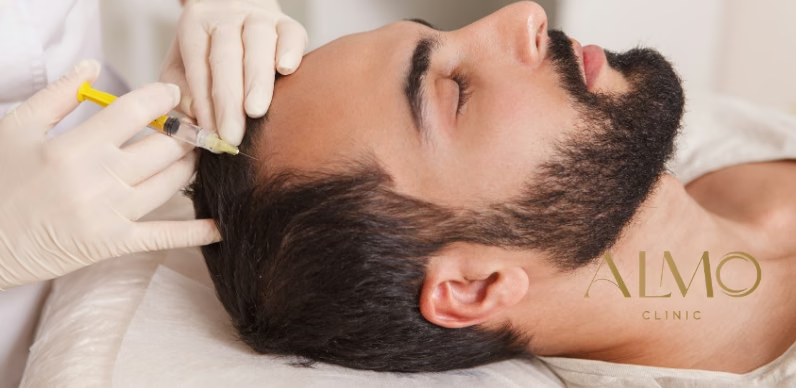
The procedure is performed under local anesthesia, meaning you remain awake and comfortable throughout. Each graft contains 1 to 4 hairs, and the number of grafts required depends on the extent of hair loss and the desired density.
Who is a candidate for hair transplant?
Not everyone with hair loss is a good candidate for a transplant. Ideal candidates share the following characteristics:
Adequate donor supply: The donor area (back and sides of the scalp) must have enough healthy, DHT-resistant follicles to provide sufficient coverage. Our team evaluates donor density using digital trichoscopy to determine candidacy.
Stable hair loss: Patients should be on medical therapy (such as minoxidil or finasteride) for at least 6 to 12 months before surgery to ensure that their hair loss is stabilized. Transplanting into active hair loss without medical management can lead to unnatural results over time.
Good general health: Conditions such as uncontrolled diabetes, bleeding disorders, or active scalp infections may affect candidacy or require postponement.
Realistic expectations: A hair transplant restores hair density but does not replicate your original 18-year-old hair. It creates the appearance of fullness and a natural hairline.
Age considerations: While there is no strict age limit, patients under 25 are evaluated carefully, as their future hair loss pattern may not yet be fully established.
Women with female pattern hair loss can also be candidates, provided they have adequate donor density and stable hair loss.
What happens on procedure day
Understanding what happens on the day of your FUE hair transplant helps reduce anxiety and ensures you are fully prepared.
Pre-procedure preparation
On the morning of surgery, wash your hair thoroughly with the antiseptic shampoo provided by the clinic. Avoid caffeine and eat a light breakfast. Wear a front-buttoning shirt (not a pullover) to avoid rubbing the grafts after surgery.
Anesthesia and sedation
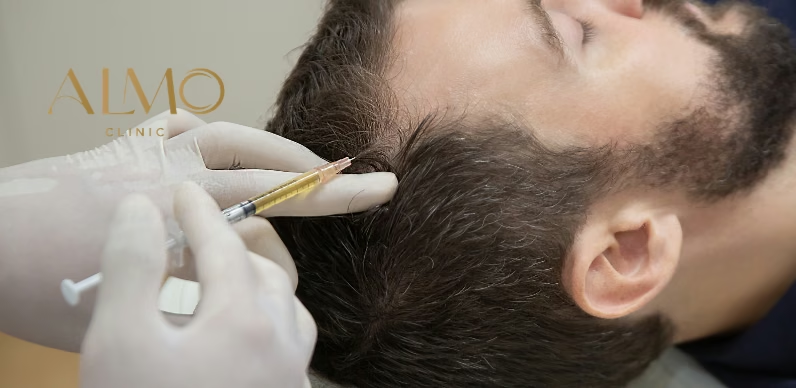
The procedure begins with local anesthesia injections to the donor and recipient areas. Most patients feel a mild stinging sensation for a few seconds, after which the scalp becomes completely numb. If desired, oral sedation is available to help you relax.
Graft extraction
Your surgeon will trim the donor area and use a specialized micro-punch tool to extract individual follicular units. This phase takes approximately 2 to 4 hours depending on the number of grafts. Throughout the process, you can listen to music, watch a movie, or take a nap.
Graft preparation
Once extracted, each follicular unit is carefully examined under a microscope by trained technicians. Damaged or low-quality grafts are discarded, and the remaining grafts are sorted by the number of hairs per unit (1-hair grafts for the hairline, 2-to-4-hair grafts for density behind the hairline).
Recipient site creation and implantation
Your surgeon creates tiny recipient sites in the balding areas, carefully planning the angle, direction, and density of each site. The grafts are then placed one by one by a team of skilled technicians. This phase takes another 2 to 4 hours.
Total procedure time for a typical session of 2,000 to 3,500 grafts is 6 to 8 hours.
Immediate postoperative appearance
After the procedure, the recipient area will have small scabs around each graft, and the scalp may appear slightly red and swollen. This is completely normal and part of the healing process. You will be given a surgical cap to wear home.
Recovery and postoperative care
The recovery after an FUE hair transplant is relatively straightforward, but following postoperative instructions is critical for optimal results.
Days 1 to 3
The first 72 hours are the most delicate. The grafts are not yet fully secured, and careful handling is essential:
- Sleep with your head elevated at 45 degrees using two pillows
- Avoid touching, scratching, or bumping the transplanted area
- Spray the recipient area with saline solution as instructed to keep grafts hydrated
- Do not wash your hair for the first 48 hours
Days 4 to 7
By day 4, the grafts are secured, and you can begin washing your hair gently with the provided shampoo. The small scabs around the grafts will begin to fall off naturally. Mild swelling in the forehead or around the eyes is normal and typically resolves within 3 to 5 days.
Days 8 to 14
Most patients return to work and social activities within 5 to 7 days. By day 10, the scabs are gone, and the transplanted hairs will be visible as small stubble. Avoid direct sun exposure, strenuous exercise, and saunas during this period.
Weeks 3 to 6
Around week 3 to 4, the transplanted hairs will shed — this is called shock loss and is a normal part of the process. Do not be alarmed. The hair follicles remain alive beneath the scalp and will begin producing new hairs within 2 to 3 months.
Months 3 to 6
New hair growth becomes visible. Initially, the hairs are thin and fine, but they will thicken over time. You may notice uneven growth during this phase.
Months 6 to 12
This is the most rewarding phase. Hair density and quality improve significantly. By month 12, approximately 80 to 90% of the final result is visible.
When do you see definitive results?
The final result of an FUE hair transplant is visible between 12 and 18 months after the procedure. The timeline follows the natural hair growth cycle:
- Month 0 to 1: Scabs heal, transplanted hairs shed
- Month 2 to 3: Initial thin regrowth begins
- Month 4 to 6: Noticeable improvement in density
- Month 7 to 9: Significant cosmetic improvement
- Month 10 to 12: Majority of result visible
- Month 12 to 18: Full maturation of hair caliber and texture
The transplanted hair is permanent because it comes from DHT-resistant follicles in the donor area. However, it is important to understand that the procedure does not stop future hair loss in non-transplanted areas. Continued medical therapy is recommended to preserve existing hair.
For a complete evaluation and surgical plan, schedule a consultation with our hair transplant specialists in Bogotá.
Frequently asked questions
Does FUE leave scars?
FUE leaves tiny, scattered dot-like scars at each extraction site in the donor area. These are approximately 0.7 to 0.9 mm and are virtually invisible once the donor hair grows back, even with very short haircuts. Unlike the FUT technique, there is no linear scar.
How long does a hair transplant last?
The transplanted hair is permanent because it is taken from the DHT-resistant donor zone. The results last a lifetime. However, existing non-transplanted hair may continue to thin over time, which is why complementary medical therapy is often recommended.
How many follicles are needed per area?
The number of grafts varies by the extent of hair loss and the desired density. Typical ranges are:
- Frontal hairline restoration: 1,500 to 2,500 grafts
- Crown/vertex: 1,000 to 2,000 grafts
- Full scalp (Norwood 4-5): 3,000 to 4,500 grafts
- Norwood 6-7 (advanced): 5,000 to 6,000 grafts (may require two sessions)
A consultation with digital trichoscopy allows precise measurement of donor density and development of a personalized surgical plan.
Is the procedure painful?
The procedure itself is not painful because it is performed under local anesthesia. Patients report mild discomfort during the initial anesthetic injections (similar to dental numbing), but this lasts only a few seconds. After the procedure, the scalp may feel sore for 24 to 48 hours. Over-the-counter pain medication is usually sufficient.
Can I travel to Bogotá for a hair transplant?
Yes. ALMO Clinic welcomes international patients from the United States, Canada, Europe, and other Latin American countries. We assist with travel planning, accommodation recommendations, and postoperative follow-up. We recommend staying 7 to 10 days in Bogotá to allow for initial healing before returning home.
Ready to plan your FUE hair transplant trip to Bogotá? Reach out to our team to start your personalized surgical plan.
Schedule your FUE consultation </a>