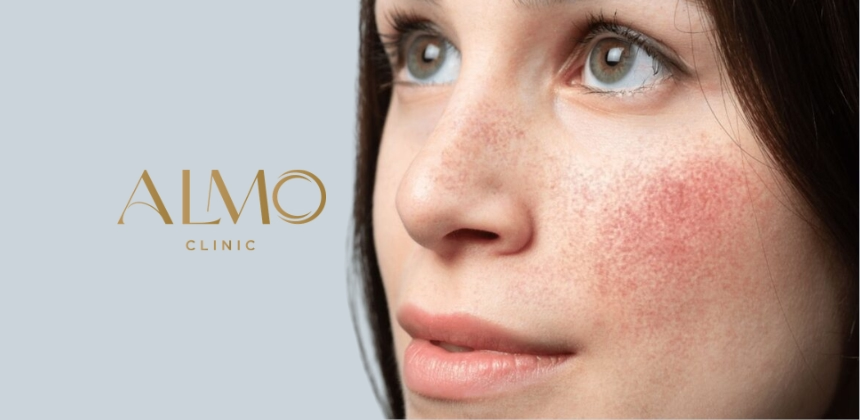
The eye area has the thinnest skin on the face, which is why most bio-stimulators are not indicated there: their particles can produce visible nodules. Juvelook has a smaller particle, allowing treatment of crow's feet, upper eyelids with lost firmness, and dark circles caused by skin thinning. It does not correct vascular dark circles or those caused by a herniated fat pad, which is a surgical problem. At ALMO Clinic in Bogotá it starts from $700 USD.
Reviewed by Dr. Oscar Barón · Cirujano plástico · SCCP
$700 USD
- Treats Crow's feet, thin skin
- Does not treat Vascular circles, fat pads
The eye contour area is the one that most reveals the passage of time — and also the hardest to treat with traditional bio-stimulators.
Crow’s feet appear early and are hard to eliminate. Deep dark circles don’t go away with rest or cream. Eyelids lose firmness over the years in a way that no serum can reverse. And when looking for an injectable treatment for those areas, the same answer always comes up: Sculptra and Radiesse cannot be applied in the periocular area.
Juvelook is the exception. It’s the only bio-stimulator in Colombia that can treat the eye contour safely — and in this article we explain exactly why, how, and what to expect from the treatment.
Why are crow’s feet so hard to treat?
The skin around the eyes is the thinnest on the entire face: approximately 0.5 mm, compared to 2 mm for the rest of the face. This extreme thinness has several consequences:
- Ages earlier: collagen loss becomes visible faster than in other areas
- Has fewer sebaceous glands: it dehydrates more easily
- Is more sensitive to expression: repeated movements when blinking and smiling accelerate the formation of dynamic wrinkles
- Most bio-stimulators cannot be used here: their particles are too large or their concentration too high for such a delicate area
Botox relaxes the muscle and can reduce dynamic wrinkles, but it doesn’t regenerate tissue or improve skin texture. For many people, the result of Botox alone is not enough — the skin still looks aged even if the wrinkles are less marked.
This is where Juvelook comes in.
Juvelook in the periocular area: what no other bio-stimulator can do
The reason Sculptra and Radiesse cannot be applied to crow’s feet or eyelids is technical:
- Sculptra (PLLA): larger particles and higher concentration. In areas of very thin skin it can cause visible nodules under the skin and doesn’t have enough precision for periocular anatomy.
- Radiesse (calcium hydroxyapatite): denser and more volumizing product. In a small amount of tissue it can give an irregular result or exceed safety limits for the eye area.
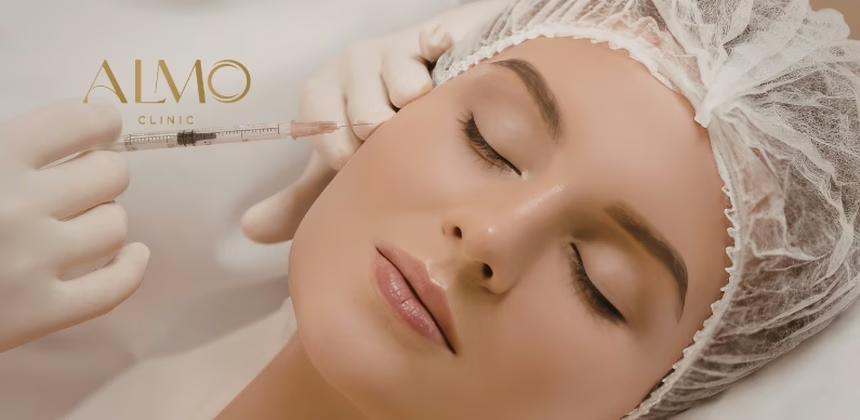
Juvelook works differently: its low-concentration PDLLA combined with non-cross-linked hyaluronic acid has the right consistency to spread evenly in thin tissues. The micro-cannula application technique — instead of conventional needle — further reduces bruising risk and allows more precise product distribution.
Why does the micro-cannula protect the delicate area?
The micro-cannula has a blunt tip — it doesn’t cut, but gently displaces tissue. This means:
- Lower risk of puncturing small blood vessels (bruising)
- More homogeneous product distribution in areas of thin tissue
- Less post-treatment inflammation
- Greater patient comfort
In the periocular area, where there are multiple small vessels and the tissue is extremely delicate, this technical difference is crucial for the safety of the result.
Treatment of crow’s feet with Juvelook: what to expect
The treatment of crow’s feet with Juvelook follows the standard protocol of 2 to 3 sessions separated by 4 weeks, with some specific adaptations for the periocular area:
Before treatment:
- Assessment of the periocular area and wrinkle type (dynamic, static, or mixed)
- Evaluation of skin hydration status
- Review of previous treatments in the area
During the session:
- Deep cleaning of the periocular area
- Application of topical anesthesia (wait 20–30 minutes)
- Injection of Juvelook with micro-cannula in crow’s feet and eye contour
- Duration: 20 to 30 minutes
Expected results:
- Improvement in hydration and luminosity from day 1 (hyaluronic acid)
- Progressive reduction of fine wrinkles starting from week 4
- Complete result visible between month 2 and month 4
- Duration: 18 to 24 months with annual maintenance
Deep dark circles: Juvelook vs conventional hyaluronic acid filler
Treatment of dark circles with injectables is delicate, and not every solution is correct for all types of dark circles.
| Type of dark circles | What works best? |
|---|---|
| Dark coloring due to pigmentation | Topical treatments, peels, laser — Juvelook is not the main indication |
| Dark circles due to tiredness and dehydration | Juvelook improves tissue hydration; moderate result |
| Deep structural dark circles (hollowing) | Juvelook stimulates collagen without adding external volume — safer option than conventional filler |
For structural dark circles — those with a pronounced shadow due to tissue hollowing, not just color — conventional hyaluronic acid filler can give a result, but it has a specific risk: the Tyndall effect. When filler HA is placed too superficially in a very thin skin area like dark circles, it can appear bluish or grayish. It’s not dangerous, but it’s essentially a visible complication.
Juvelook doesn’t add external volume — it stimulates own collagen. This reduces the risk of Tyndall effect because there’s no visible product under the thin skin, but production of the patient’s own tissue.
Drooping eyelids without surgery: when Juvelook can help
Here it’s important to be very clear about the treatment’s limits.
Juvelook on eyelids can:
- Improve eyelid skin quality and hydration
- Reduce superficial mild sagging of eyelid skin
- Improve texture and overall appearance of the area
Juvelook on eyelids cannot:
- Correct real ptosis (eyelid drooping due to muscle weakness)
- Replace blepharoplasty in cases of moderate to severe excess skin
- Act on the eyelid levator muscle
If there is real ptosis — that is, the eyelid falls over the pupil affecting vision or aesthetically significantly — surgical blepharoplasty is the only definitive treatment. Juvelook complements but does not replace that procedure.
For cases where there is superficial sagging of eyelid skin without real ptosis, Juvelook can provide visible improvement that many patients value as a natural and sufficient result.
How many sessions do I need and how long do results last?
| Period | What happens in the periocular area? |
|---|---|
| Day 1 | Visible hydration, improved luminosity |
| Week 2–4 | Start of collagen stimulation in periocular dermis |
| Month 2–4 | Visible reduction of fine wrinkles and texture improvement |
| Month 6–24 | Maintained effect in eye contour |
| Maintenance | Annual session to prolong the result |
The standard protocol is 2 to 3 sessions for the periocular area. In some people with very marked wrinkles or very dehydrated skin, the specialist may recommend 3 sessions to obtain the optimal result.
SAFETY ALERT — information you need to know
There is a higher-concentration version of Juvelook known as Juvelook Volume or Lenisna that was involved in a documented ocular complication case in 2025. This version SHOULD NOT be applied in the periocular area under any circumstances.
Juvelook standard — the only one we use at ALMO Clinic — has a lower-concentration formulation specifically designed for delicate areas, with a different and well-documented safety profile.
The difference between a safe result and a complication in the periocular area lies in three factors:
- The correct product: Juvelook standard, not Juvelook Volume
- The certified specialist: with specific training in periocular anatomy
- The proper technique: micro-cannula, precise distribution, correct amount
At ALMO Clinic, we are the exclusive distributors of Juvelook with protocols certified by the product’s original trainers (Dr. Hong-seok Kim, Dr. Lee Jin-seok). Before any application in the periocular area, we perform a detailed assessment to confirm that the treatment is safe in your specific case.
Frequently asked questions about Juvelook in the eye contour
How many Juvelook sessions do I need for crow’s feet? The standard protocol is 2 to 3 sessions separated by 4 weeks. The complete result is noticeable between month 2 and month 4 after the last session.
How does Juvelook work on eye contour skin? PDLLA activates periocular area fibroblasts to produce their own collagen. Hyaluronic acid hydrates the tissue from day one. The result is an improvement in texture, firmness, and hydration that progresses over several months.
When are Juvelook results visible in crow’s feet? The improvement in hydration and luminosity is visible from the first day. The reduction of fine wrinkles begins to be noticeable between week 4 and month 2. The complete result is visible between month 2 and month 4 after the full protocol.
Is it safe to apply Juvelook near the eye? Juvelook standard, applied with micro-cannula by a certified specialist, has a well-documented safety profile in the periocular area. It’s crucial to distinguish it from Juvelook Volume, which is contraindicated in that area.
Does Juvelook permanently eliminate crow’s feet? Juvelook significantly reduces fine eye contour wrinkles and improves skin texture. The effect lasts between 18 and 24 months. It doesn’t permanently eliminate wrinkles, but the result with annual maintenance can be maintained indefinitely.
If crow’s feet, dark circles, or eyelids concern you and you want to explore if Juvelook is the right treatment for your case, the next step is a personalized assessment at ALMO Clinic.
For a comparison with Botox — the most used treatment for crow’s feet — read our article on Juvelook vs Botox for crow’s feet.
Wondering if Juvelook is safe for your specific eye contour concerns? Our medical team can walk you through it.
Ask about periocular Juvelook </a>