In summary
Laser lipolysis liquefies fat with laser energy before aspirating it, which reduces trauma to the tissue and delivers some skin retraction. Conventional liposuction aspirates mechanically and does nothing to the skin. Neither replaces surgery when there is genuine excess skin. At ALMO Clinic in Bogotá the option with the most documented retraction is BodyTite (radiofrequency-assisted), from $2,125 USD, while liposculpture starts from $1,500 USD.
Reviewed by Dr. Martha Peñarredonda · Plastic surgeon · SCCP
$1,500 USD
- BodyTite from $2,125 USD
- With excess skin Surgery required
Last updated: July 2026 · Reviewed by Dr. Martha Peñarredonda
“Laser lipo” is one of the most searched body contouring terms — and one of the most loosely used. It is offered everywhere from med spas to certified operating rooms, with very different technologies and safety standards sold under the same name. This guide clarifies what laser lipolysis actually is, how it differs from liposuction, and which medical criteria determine the right choice.
What is laser lipo and how does it work
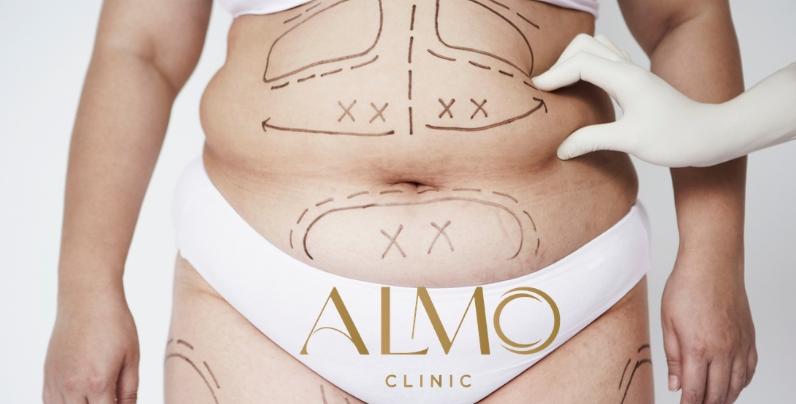
Laser lipolysis is a minimally invasive procedure in which a thin laser fiber is inserted under the skin to heat and rupture fat cell membranes. The liquefied fat is then removed by gentle suction or, in very small volumes, metabolized by the body. The laser’s heat also stimulates some collagen production in the dermis.
Liposuction (or liposculpture, when the goal is sculpting the contour rather than just removing fat) uses cannulas connected to a suction system to remove fat mechanically. It can treat much larger volumes in a single session and remains the most performed body contouring procedure worldwide.
The practical difference is not which one is “better” — it is scale: laser lipolysis is a precision tool for small areas; liposuction is the solution for moderate to high volumes.
Laser lipo vs liposuction: the numbers
| Factor | Laser lipo | Liposuction / liposculpture |
|---|---|---|
| Mechanism | Laser energy that liquefies fat | Mechanical suction with cannulas |
| Treatable volume | Small (double chin, arms, spot areas) | Moderate to high (up to 5 liters) |
| Anesthesia | Local | Local + sedation or general |
| Incisions | 1-2 mm | 3-10 mm |
| Effect on skin | Mild heat-induced tightening | None (may worsen laxity) |
| Back to work | 2-4 days | 7-14 days |
| Main risk | Burns, insufficient result | Irregularities, seromas, more trauma |
| Required setting | Licensed surgical facility | Certified operating room |
Risks: what to know before deciding
Risks of laser lipolysis
Heat is both its advantage and its risk. A poorly controlled laser fiber can cause internal or superficial burns, and on large areas the result is usually insufficient, forcing repeat sessions or conversion to liposuction. Risk rises sharply when the procedure is performed outside a licensed medical facility or by non-surgical staff — common in the commercial offer of “non-surgical lipo”.
Risks of liposuction
Like any surgery, it involves anesthesia, tissue trauma and swelling. Specific risks include contour irregularities, seromas and, in high volumes, hemodynamic changes. In a certified operating room with a board-certified plastic surgeon, complication rates are low; our plastic surgery safety guide for Colombia explains exactly which credentials to verify.
The golden rule
Either technique is only as safe as the setting and the specialist performing it. Always verify: SCCP board-certified surgeon, facility licensed by the health authority, and an in-person assessment first.
Which one to choose for your case
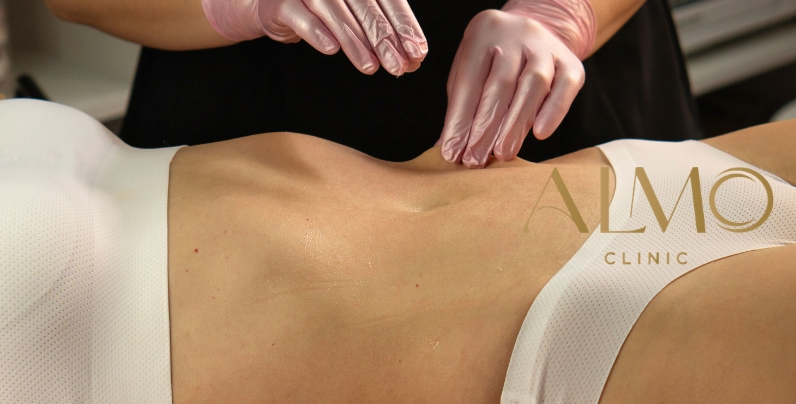
Laser lipo makes sense if the fat deposit is small and localized (double chin, inner arms, knees), your skin has good elasticity and you want a recovery of just a few days.
Liposuction / liposculpture is the indication when the fat to remove is moderate or abundant, several areas need treatment, or you want a visible contour change in a single intervention. Our liposculpture in Bogotá page details techniques, treatable areas and candidates.
Neither of the two solves skin laxity. If there is loose skin in addition to fat, removing volume can make sagging worse.
The alternative that combines both: RF-assisted lipolysis
The technological evolution of lipolysis did not stop at lasers. Radiofrequency-assisted lipolysis (RFAL) — the technology behind BodyTite — liquefies fat with controlled heat, like laser lipo, but adds real-time thermal monitoring and a documented skin contraction of up to 47%, far superior to laser. For patients drawn to “laser lipo” for its fast recovery but who have some skin laxity, it usually offers the best result-to-risk ratio.
The full comparison is in BodyTite vs traditional liposuction.
Frequently asked questions
Is laser lipo the same as “non-surgical lipo”?
No. Laser lipolysis is an invasive procedure (the fiber goes under the skin). External treatments marketed as “non-surgical lipo” (cold laser, cavitation, devices) act from outside and deliver far more modest, temporary results.
How many sessions does laser lipo take?
In its surgical form, generally one per area. If you are offered packages of many sessions, it is probably external device therapy, not true laser lipolysis.
Does laser lipo leave scars?
Incisions are 1-2 mm and usually become imperceptible. Liposuction uses slightly larger incisions (3-10 mm) placed in natural creases.
Can I switch from laser lipo to liposuction?
Yes. It is common for patients with insufficient results after laser treatment of large areas to end up needing formal liposculpture. That is why the right indication from the start saves money and procedures.
Decide with an assessment, not with advertising
Laser lipo is a good tool with the right indication: little fat, good skin, small area. Liposuction remains the standard for everything else, and RF-assisted technology covers the middle ground when skin laxity is present. What defines your result is not the name of the technology but the diagnosis: fat volume, skin quality and body proportion.
At ALMO Clinic, a board-certified plastic surgeon evaluates your case and recommends the technique with the best result-to-safety ratio for your anatomy — with a closed quote and follow-up care included. We welcome international patients in Bogotá.
Book your specialist assessment