There are four common types of alopecia. Androgenetic alopecia is hereditary, progressive and affects specific zones — temples and crown in men, diffuse in women. Telogen effluvium is a diffuse, reversible shedding after childbirth, surgery or intense stress. Alopecia areata produces round bald patches and is autoimmune in origin. Scarring alopecias destroy the follicle irreversibly and require urgent dermatological diagnosis, because what is lost cannot be recovered.
Reviewed by Dr. Oscar Barón · Cirujano plástico · SCCP
Androgenetic
- Reversible Telogen effluvium
- Urgent Scarring alopecia
Not all hair loss is the same. Using the word “alopecia” as if it were a single condition is like using “cancer” to refer to every type of cancer: each type has different causes, different mechanisms, and — most importantly — specific treatments.
This guide breaks down the main types of alopecia according to medical classification, explains how to identify each one, and details which treatments have evidence for each. If you are losing hair, the first step is not to look for a treatment — it is to know which type of alopecia you have.
Androgenetic alopecia (the most common)
Androgenetic alopecia is by far the most frequent type of hair loss. It affects approximately 50% of men over 40 and 25% of women in the same age range.
What causes it?
It is a genetic and hormonal condition. Hair follicles in genetically predisposed individuals are sensitive to dihydrotestosterone (DHT), a byproduct of testosterone. DHT binds to follicle receptors and, over time, shortens the growth cycle until the follicle stops producing visible hair.
Norwood scale in men
In men, androgenetic alopecia follows a predictable pattern described by the Norwood scale:
- Stage I–II: Minimal hairline recession at the temples
- Stage III: Moderate recession at the hairline and crown
- Stage IV–V: Frontal and crown areas connected, forming a horseshoe pattern
- Stage VI–VII: Extensive baldness with only a band of hair in the occipital area
The Norwood scale is useful for classifying severity, but early treatment makes all the difference: in early stages it is possible to stop progression and recover density; in advanced stages the main option is FUE hair transplant.
Ludwig scale in women
In women, androgenetic alopecia typically presents as diffuse thinning on the top of the scalp, usually preserving the frontal hairline. The Ludwig scale classifies it in three grades:
- Grade I: Mild thinning at the crown
- Grade II: Moderate thinning with the scalp visible
- Grade III: Severe and diffuse thinning
Importantly, androgenetic alopecia in women rarely progresses to complete baldness, but can be equally distressing and requires a different treatment approach compared to men.
Treatment options
First-line treatment includes topical minoxidil (for men and women) and oral finasteride (for men only — contraindicated in women of childbearing age). In more advanced stages or when medication is insufficient, FUE hair transplant is considered, harvesting follicles from the donor area (occipital) and implanting them in thinning zones.
Alopecia areata
Alopecia areata is an autoimmune disorder in which the immune system attacks hair follicles, causing well-defined patches of hair loss.
What causes it?
The exact cause is not fully understood, but it is known to be an autoimmune disease with a significant genetic component. Triggering factors such as severe stress, viral infections, or hormonal changes may activate the immune response in predisposed individuals.
Clinical presentation
It typically presents as one or several round, smooth patches of hair loss on the scalp. Unlike other types of alopecia, the skin of the affected patch looks completely normal — no inflammation or scaling.
There are several forms of presentation:
- Focal alopecia areata: One or a few patches on the scalp
- Alopecia totalis: Complete loss of all scalp hair
- Alopecia universalis: Loss of all body hair, including eyebrows and eyelashes
- Ophiasis alopecia areata: Band-shaped patch along the occipital area
Signs of poor prognosis include: onset in childhood, family history, prolonged duration of the current episode, and extensive involvement.
Available treatment
Treatment depends on the extent and activity of the disease. For mild cases (a few patches), topical or intralesional corticosteroids are the first line. For extensive or resistant cases, topical immunosuppressants such as cyclosporine or more advanced therapies like JAK inhibitors — which have shown promising results in recent studies — may be used, though their availability varies by country and requires specialist supervision.
Alopecia areata has the characteristic that it can resolve spontaneously in around 50% of cases, but it can also recur. The prognosis is unpredictable, making continuous medical follow-up important.
Telogen effluvium (acute and chronic)
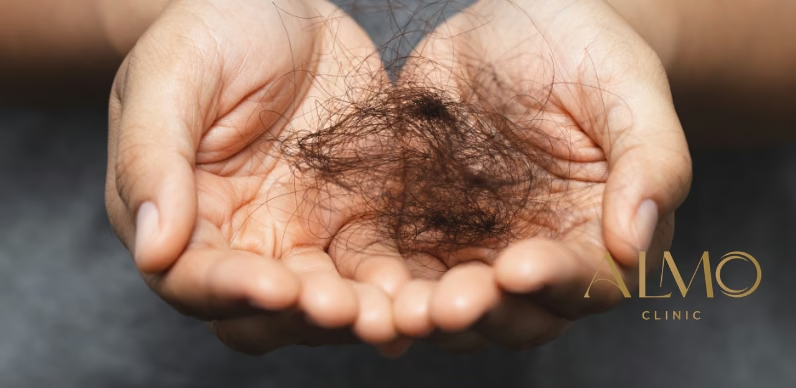
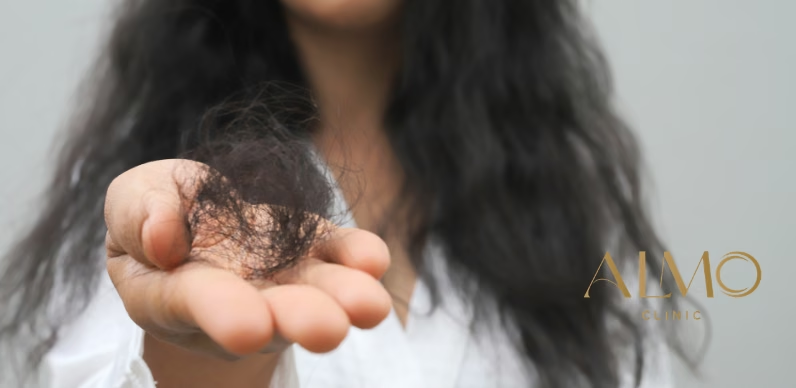
Telogen effluvium is perhaps the type of alopecia that generates the most consultations because its presentation is striking: the patient loses large amounts of hair suddenly, often in handfuls while washing or brushing.
Acute telogen effluvium
It is characterised by diffuse, massive hair loss that occurs 2 to 3 months after an identifiable triggering event. Typical triggers include:
- Childbirth (postpartum hair loss)
- Major surgery
- Febrile illness (especially dengue, COVID-19)
- Rapid weight loss or extreme diets
- Severe emotional stress
- Physical trauma
The good news is that acute telogen effluvium is self-limiting. Once the triggering factor resolves, hair begins to recover on its own within 3 to 6 months. The role of medical treatment is to accelerate that process and minimise the aesthetic impact during the shedding phase.
Chronic telogen effluvium
When shedding persists for more than 6 months without a clear trigger, it is classified as chronic. This type is more common in women aged 30 to 60 and usually has multiple contributing factors: prolonged stress, nutritional deficiencies, thyroid disorders, or anaemia.
Chronic telogen effluvium is more complex to manage because it rarely has a single cause. It requires a comprehensive approach with full blood tests, lifestyle assessment, and frequently a combined treatment plan including hair PRP and mesotherapy.
How to distinguish it from other types?
The key characteristic of telogen effluvium is that the shedding is diffuse — it affects the entire scalp equally, without leaving localised bald patches. The trichoscope shows a characteristic pattern of empty follicles and an elevated proportion of hairs in the telogen phase. Differential diagnosis is important because telogen effluvium can overlap with early androgenetic alopecia, and confusing the two leads to incorrect treatment.
Scarring alopecias
Scarring alopecias are a less common but more serious group of hair disorders. Unlike the types described above, here the hair follicle is irreversibly destroyed by an inflammatory process that leaves scar tissue.
What sets them apart?
The most evident sign is that the area of hair loss has no visible follicles — there are no follicular dots on the scalp — and the skin may appear abnormal: whitish, shiny, atrophic, or showing signs of inflammation such as redness and scaling.
Main types
- Lichen planopilaris: Lichenoid inflammation around the follicle. Presents with patches of loss and signs of inflammation at the active border. May be accompanied by skin and mucous membrane involvement.
- Discoid lupus erythematosus: Erythematous, scaly lesions that leave scarring. It is important to rule out systemic lupus when this variant is diagnosed.
- Frontal fibrosing alopecia: A variant of lichen planopilaris that causes recession of the frontal hairline, particularly in postmenopausal women. Its incidence has increased significantly over the last decade.
- Folliculitis decalvans: Chronic infectious-inflammatory process that destroys follicles.
Treatment and prognosis
Treatment must begin early to stop progression before damage becomes extensive. Potent anti-inflammatory agents (corticosteroids, hydroxychloroquine) are used, and in resistant cases, systemic immunosuppressants.
Once the follicle has been destroyed, the lost hair cannot be recovered. The goal of treatment is to stop the active inflammation and preserve the remaining healthy follicles. In stable cases, hair transplant can be considered in non-active scarred areas, but only under specialist trichological supervision.
Minoxidil or finasteride? When they enter the treatment plan and when they are not enough
The minoxidil vs finasteride discussion is one of the most common in trichology consultations. The short answer is that they are not interchangeable: they act through different mechanisms and are indicated for different types of alopecia.
Minoxidil: the growth stimulator
Minoxidil is a topical vasodilator that stimulates blood flow to the hair follicle and prolongs the hair growth phase. It is approved for both men and women with androgenetic alopecia, and also has utility in telogen effluvium and mild alopecia areata.
It comes in concentrations of 2% and 5%. In men, the 5% concentration has shown greater efficacy. In women, 2% is the approved presentation, although 5% is used under medical supervision due to the risk of hypertrichosis (hair growth in unwanted areas).
The main limitation of minoxidil is that it requires continuous use: when stopped, the hair gained is lost within 3 to 6 months. It also does not act on the underlying hormonal cause of androgenetic alopecia.
Finasteride: the hormonal blocker
Finasteride is an oral medication that inhibits the 5-alpha-reductase enzyme responsible for converting testosterone to DHT. By reducing DHT levels, it protects sensitive follicles from progressive miniaturisation.
It is indicated exclusively for male androgenetic alopecia. It is contraindicated in pregnant women or women of childbearing age due to the risk of malformations in a male foetus.
Finasteride results take time: at least 6 months of continuous use are needed to notice improvement, and the maximum effect is reached at one year. Like minoxidil, it requires continuous use; stopping it allows DHT to return to normal levels and shedding resumes.
When are they not enough?
Both minoxidil and finasteride have limited efficacy in advanced stages of alopecia. In patients with Norwood V or above, or Ludwig grade III, the follicles have already been destroyed and no medication can recover them.
In those cases, the effective option is FUE hair transplant, which redistributes healthy follicles from the donor area to the depopulated zones. For extensive alopecia areata, scarring alopecias, or chronic telogen effluvium, these medications are not the right answer either.
The decision between the two (or their combination) must be made by a trichologist after precise diagnosis of the alopecia type — not before.
How the type of alopecia is diagnosed
Diagnosing the type of alopecia is not done by eye alone. It requires specific evaluation tools that only a certified trichologist can perform and interpret correctly.
Digital trichoscopy
Digital trichoscopy is the gold standard for alopecia diagnosis. It uses a high-resolution digital microscope that allows the specialist to examine the scalp follicle by follicle. With this tool it is possible to:
- Measure hair density per zone
- Assess hair shaft diameter
- Identify signs of follicular miniaturisation
- Detect empty or damaged follicles
- Visualise signs of inflammation or fibrosis
Each type of alopecia has a characteristic trichoscopic pattern. Androgenetic alopecia shows diversity in hair shaft diameter (anisotrichia), alopecia areata shows yellow dots and exclamation mark hairs, and scarring alopecias show loss of follicular openings.
Complementary blood tests
A complete blood profile is part of the diagnosis: ferritin, vitamin D, zinc, thyroid profile (TSH, T4), sex hormones, and autoantibodies when alopecia areata or autoimmune diseases are suspected.
Scalp biopsy
In doubtful cases or when a scarring alopecia is suspected, scalp biopsy is the definitive test. It allows analysis of follicular tissue at the histopathological level and precise determination of the exact type of alopecia.
If you do not know which type of alopecia you have, the first step should be an advanced trichological diagnosis at ALMO Clinic, where we identify the precise cause before recommending any treatment.
Frequently asked questions
What is the most common type of alopecia?
Androgenetic alopecia is the most frequent type, affecting 50% of men and 25% of women over the course of their lives.
Does alopecia areata heal on its own?
In approximately 50% of cases, alopecia areata patches resolve spontaneously within a year. However, recurrences are frequent and extensive cases require specialist medical treatment.
Does telogen effluvium lead to complete baldness?
No. Telogen effluvium causes diffuse hair loss but rarely progresses to complete baldness. It is reversible in most cases once the triggering factor is controlled.
What is the difference between minoxidil and finasteride?
Minoxidil stimulates hair growth by increasing blood flow to the follicle, while finasteride blocks the DHT hormone that causes loss in male androgenetic alopecia. They are not interchangeable and must be used according to the diagnosed type of alopecia.
Does hair transplant work for every type of alopecia?
No. FUE hair transplant is indicated primarily for stable androgenetic alopecia. It is not appropriate for active scarring alopecias, extensive alopecia areata, or active telogen effluvium.
Identifying the type of alopecia is the first step towards effective treatment. At ALMO Clinic we perform trichological diagnosis with a digital trichoscope and design a personalised plan according to your specific type of alopecia. Schedule your consultation with our trichology specialists.
Not sure which type of alopecia you have? Reach out directly and we’ll guide you toward the right diagnosis.
Ask about your type of alopecia </a>