In summary
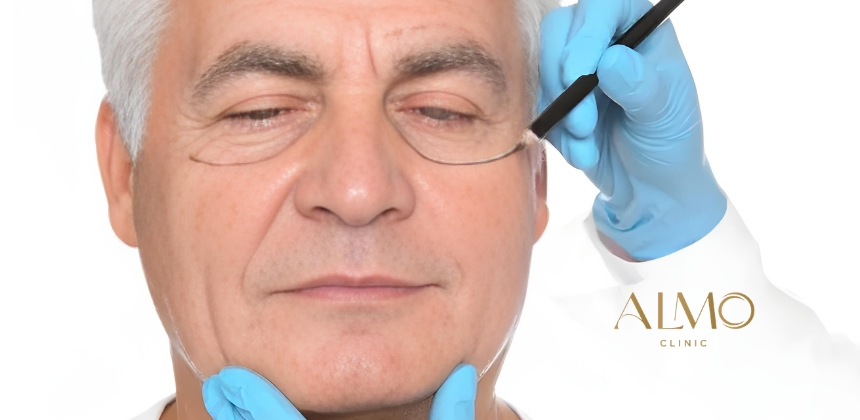
Male blepharoplasty follows its own criteria: the goal is to remove excess skin without lifting the brow or hollowing the eyelid, because a high brow or a marked crease feminises the gaze. Male eyelid skin is thicker and the brow naturally lower and straighter, so less tissue is resected than in women. At ALMO Clinic in Bogotá two-eyelid surgery starts from $1,750 USD, with social recovery of 7 to 10 days.
Reviewed by Dr. Oscar Barón · Plastic surgeon · SCCP
From $1,750 USD
- Key criterion Do not lift the brow
- Social recovery 7–10 days
The man who comes in for a blepharoplasty consultation shares the same problem with women — drooping eyelids, persistent bags, permanently tired appearance — but comes with different motivations and different expectations.
In most cases, a man isn’t looking to obviously look younger. He wants to look rested. Alert. Like his appearance matches how he actually feels. And he wants nobody to notice he had anything done.
That has concrete technical implications.
Why more men are choosing blepharoplasty
Male cosmetic surgery grew more than 30% in the last decade in Latin America, according to data from the International Society of Aesthetic Plastic Surgery (ISAPS). Blepharoplasty is one of the procedures that saw the biggest increase in that segment.
The reasons are practical. In competitive professional environments, a chronic tired appearance can be read as lack of energy or capacity. A 48-year-old man with severely drooping eyelids can look 58. The surgical correction isn’t vanity — it’s a personal image tool with a direct impact on professional and social life.
Additionally, men tend to be more conservative with maintenance treatments (creams, wellness procedures, non-invasive treatments) and accumulate more changes before seeking a solution. By the time they come to a consultation, the degree of correction needed is usually greater.
How is male blepharoplasty different?
Blepharoplasty in men follows the same principle as in women: remove excess skin, herniated fat, and redundant tissue from the eyelid. But there are meaningful technical differences:
Incision design and eyelid fold: In women, the upper eyelid fold typically sits 8 to 10 mm above the lash line. In men, the natural fold is lower — 6 to 8 mm — and that needs to be respected. Creating a high feminine fold on a male eyelid is the most common mistake that produces an “operated” result.
Amount of skin removed: The surgeon needs to be more conservative with how much skin they remove. A male eyelid with over-correction loses the “prominent brow” look that’s typical in masculine anatomy and can produce a feminine or surprised appearance.
Orbital fat: Men tend to have more fat volume in the brow area (superior retroorbital fat) that contributes to the heavy eyelid look. Managing this fat is different from handling standard eyelid fat.
Thicker skin: Male skin is on average thicker and has a higher density of hair follicles in the lateral eyelid areas. This affects the closure technique and the type of suture used to minimize scarring.

Natural result: the technical priority
The goal in male blepharoplasty isn’t a dramatic result. It’s a result that looks natural — like the patient got a good night’s sleep, lost some weight, or just looks “better” without anyone being able to put their finger on why.
To achieve this, the surgeon must respect three principles:
Maintain the horizontal alignment of the eyelid margin. A slight upward angle at the outer corner of the eye gives a feminine look. The male eye is more horizontal.
Preserve some “weight” in the upper eyelid. A male eyelid with a high, wide-open fold can look artificial. A moderate degree of depth is more consistent with masculine anatomy.
Don’t create a marked supratarsal arch. A pronounced arc on the upper eyelid border is associated with the feminine eyelid. In men, the transition should be softer.
What problems does it fix in men?
The reasons men come in follow a consistent pattern:
- Tired or overly serious expression that doesn’t match their actual look
- Bags under the eyes that are there regardless of how much they sleep
- Upper eyelids that droop over the lashes or reduce the eye opening
- Eyelid asymmetry that has gotten more pronounced with age
- In some cases, limited visual field from severe ptosis
Common combinations in male patients
Men often combine blepharoplasty with other procedures in the same surgical session to maximize results and reduce total recovery time:
Blepharoplasty + rhinoplasty: The most common combination in men. Improves harmony in the middle and upper third of the face in a single session. Learn about rhinoplasty at ALMO →
Blepharoplasty + facelift: For men over 55 with generalized facial sagging in addition to the eyelid issue. Learn about facelift →
Blepharoplasty + CO2 laser: When the periocular skin has sun spots, uneven texture, or fine wrinkles that benefit from simultaneous laser treatment. Learn about CO2 laser →
Recovery in men: what changes
The physical recovery of blepharoplasty is the same for men and women: sutures removed between day 5 and 7, presentable appearance in week 2, final result between month 3 and 6.
What changes are some practical considerations:
- Men tend to have more physical activity in their daily routine. The surgeon needs to give clear guidance on when to resume exercise (minimum 4 weeks for high-intensity workouts).
- Shaving near the lower eyelid area should be avoided for the first 7–10 days.
- Most men want to get back to work as soon as possible. With sedentary work, this is feasible in the second week.
The complete recovery guide applies to both men and women, with the specific considerations the surgeon will detail in the preoperative consultation.
Confidentiality
A question that comes up often in male consultations is discretion. At ALMO Clinic, as at any certified medical clinic, all patient information is protected by medical confidentiality. The surgery, the quote, and follow-up are all confidential by definition.
If you recognize your situation in this article, the next step is a medical evaluation. At ALMO Clinic we assess your eyelid anatomy, determine which type of blepharoplasty fits your case, and explain the expected result with technical clarity and zero pressure.
See all the details about blepharoplasty →
Ready for a confidential, no-pressure evaluation of your eyelids? Reach out to our medical team directly.